Copied with permission from Alex Tsui, Muay Thai historian: Alex Tsui's Facebook
The Unforgiving Kicks, part 22 of 23
The Unforgiving Kicks Part 22
30 October 2026 · by Alex Tsui
Written by Alex Tsui, a long-form series of articles on the great kickers of Muay Thai history
The Thriller (Heartstop) Kicker
On recounting the best kickers of the 80’s, the story of Nokvid Devy must not be missed.
His ring name Nokvid, means Silver Cockeral (fighting cock), known for his adroit style of kicking – painful low-cutting leg kicks reinforced by headhunt high fliers – very traditional Thai-style footwork. A great defensive fighter, he could brawl, mix it up, or simply kick-box at long range, to inflict maximum damage without getting hurt himself. He had the ringcraft and IQ to make a super champion.
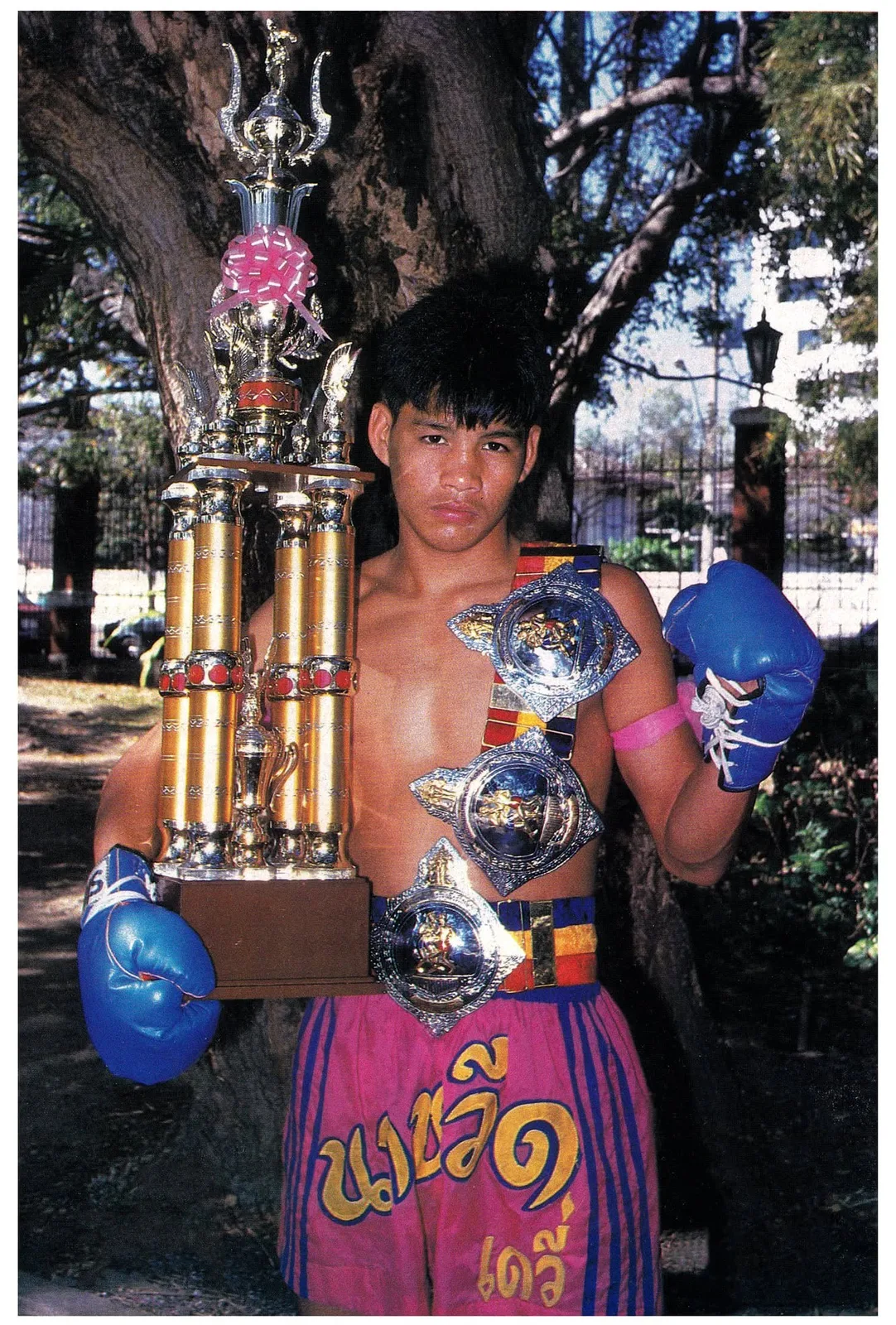
He was a legend with a life of mixed merits and faults. A born southerner, from Chumporn, fought all his way to the top, by winning three RDN titles (122. 126 & 130 divisions), reaching his peak in 1986 eliminating the celebrated Sakad and Krongsak, thus entitled to a crack at the Yodmuaythai throne of Dieselnoi. Though regarded by critic as the best talent around, destiny of having that prestige somehow chose to avoid him, for after he was unexpectedly beaten by Wanpadej in a Jr.-lightweight title match, the top fight was aborted upon Dieselnoi’s official retirement in February, 1987.
His conquests continued and, after many setbacks, finally won the WMC world title (69 Kg.) by beating Dany Bille of France (1995). In his lengthy career, which had taken him to the United States, Japan, Australia and South Africa, among the many great dramas of fond memory to fans worldwide, three were special,
as each indeed epitomized a distinctly varied attribute of muaythai, through the evidence of his performance.
Clash of the Century in Tokyo
In the big card, “Clash of the Century II”, at the renowned Korakuen Hall, 18 March, 1990, was a double-header featuring England ‘s “Black Knight” Ronnie Green vs. Sakad (the legend) of Thailand, and Nokvid (Great Kicker) vs. Dutch WKA world champion Iwan Grant.
Nokvid, 143, coming out of a year-long lay-off with only five days training, was caught cold soon, floored twice for eight counts, by sharp punches to the jaw. He looked real bad and shaken, while in imminent peril, all he had left in that fateful first round was an undying heart. It did seem logical that the black champion (138) from Holland was going to finish the night early… but not to the fighting cock from Thailand.
Nokvid held tightly to a closed guard, and survived the merciless pounding for the rest of the round, and then, started to fight back in the second. Midway through the round, the tide was seen to turn, as he chased the opponent to the ropes, firing off sporadic kicks at the man in a programmed demolition exercise. Round three was all Nokvid’s, as he unleashed a total of 33 kicks, high and low, at his foe, at least four connecting on the head. Half-paralyzed, Grant was completely at his tormentor’s mercy, the constant pounding now taken away his legs, as he, trapped at the ropes, took terrific punishment. The state of oblivion to pain shown by the Dutch warrior was simply astonishing.
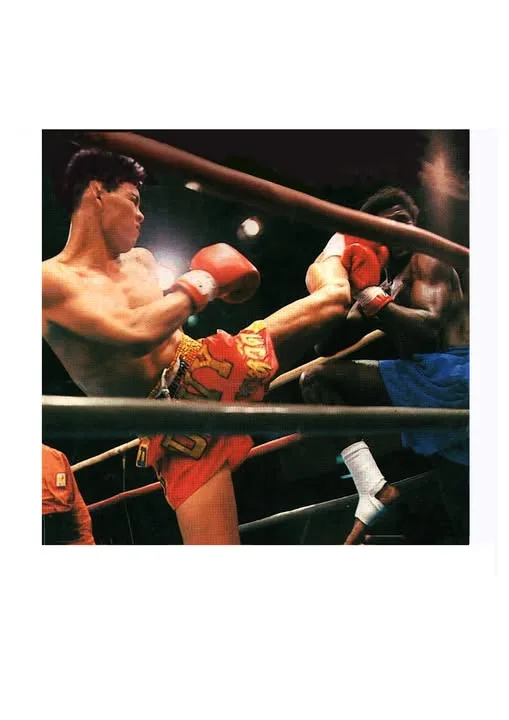
By round four, eight more kicks had Grant take a standing 8-count, a life-saving breather, but when driven to a corner, with the Thai landed two more left fliers to the head, he received another 9-count. Wasting no time, Nokvid pounced in like a lion, once the fight resumed, throwing a barrage of punches and kicks at the helpless victim... but the referee intervened, in good time, to stop the slaughter on a TKO.
It was one hell of a thriller, as the Thai kicker began as almost a sure-loser on TKO, managed to turn the fight around, sensationally, to salvage his esteem by blasting the tough Dutchman into shreds. Clash of the Century, for a billing title, could not have been more concordant.
The paradox in the event was that, had the Thai been in peak condition, he might have finished the debate in two rounds, and the great drama that had come into play would never have realized. It could have been only another night out for all we know.
The Battle of Ayutthaya 1991
This great battle, presented by the incomparable Songchai Ratanasuban, on 15 February, 1991 was one of the best muaythai classics ever seen, between Nokvid (Chumporn) and Isara Sakgrirind (Trang) – both southerners, in an awesome struggle of styles, between a versatile kickboxer and a robust southpaw slugger.
Nokvid, having regained much his old form fighting since 1990, was evenly matched against the LPN 135–pound champion, real name Arkhom Chenglai, who had outfought the famous Ramon Dekkers, and was soon to become an Olympic boxing bronze medalist in Barcelona.
Scheduled at 142 pounds, Nokvid boxed well initially, landing a beautiful high kick to the neck in the first. Leading the fight into the second, he met stern resistance from Isara, by his fistic combos, and left kick. But Novid was bidding his time, and countered effectively throughout, with scores about even. The tempo of battle became intense in the third, as Nokvid tried to take control, with a back elbow (missed) and a crash down. Isara dished out two low kicks, but received, in return, a hard right to the neck, before being tossed down. Isara could not have survived had he not been in top condition. The kicker fired altogether seven high fliers to the head, connecting at least two, others missing by barely an inch, but failed to put his man down. Nokvid’s round.
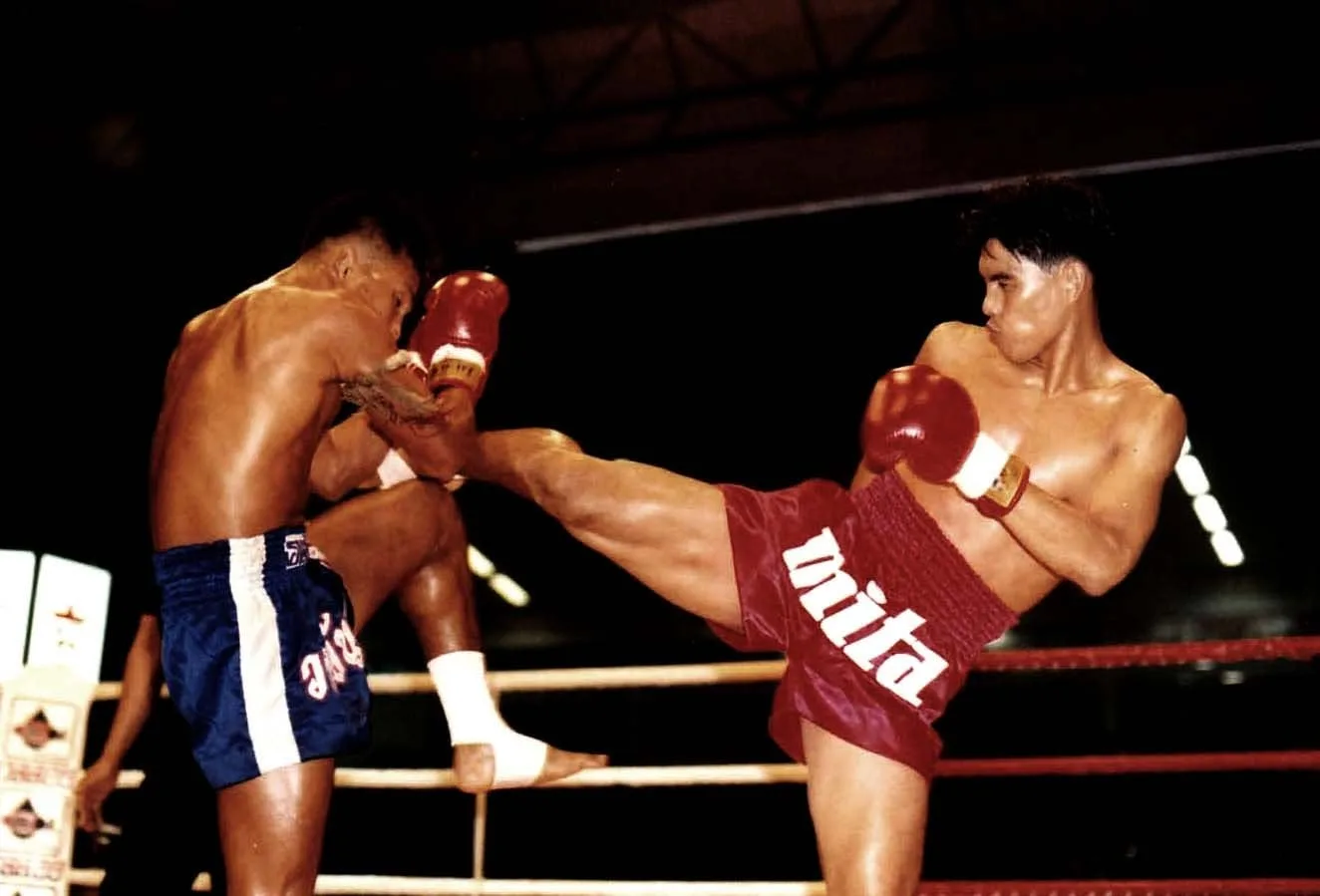
Round four was absolute insanity, as Isara retaliated by firing, non-stop, a volley of 150 punches at his foe, when both threw caution into the wind, and engaged in a give-and-take wild brawl. Isara came out the stronger landing more, with Nokvid hanging on for life, yet still punching mad. He was practically out on his feet, but would not fall, and kept retorting with blows of his own. At the sound of the bell, he staggered back to his corner just like a drunken man. Best round ever.
In the fifth and last round, a revived Nokvid attempted a rally but Isara boxed clever, scoring with left kicks and punches to neutralize the advances of the weakened kicker. Still one high right from Nokvid found its target, but clearly Isara was the stronger, to win the hard-earned decision.
This was a defining one for the history books, and, for the record, the two adversaries had since met again, with Novid winning the encore , but yet again outfought in the rubber match.
David vs. Goliath, K-1 Dream Match
That the Thai fighting against a physical disadvantage of 33 ( 72.6 pounds) kilos must lose is fait accompli. The author has no intention of revisiting the fighting sequence that was played out in those hectic rounds. Nokvid lost fairly and squarely, as per the rules, and there was no debate or any shame attached to it. Rather, it was a very special kind of accolade, for it has become, through the keen observations of muaythai scholars worldwide, a testament of the intrinsic values of muaythais : how to survive against a hopelessly oversized and dangerous opponent, and emerged relatively unharmed. That was what Nokvid achieved exactly in those fateful 15 minutes of interaction.
French champion Le Banner was a formidable rival, young, rising heavyweight (107) kickboxer feared in Europe, having won 9 of his 10 fights since 1992. Nokvid, (74) on the other hand, had declined from his peak in 1987 and had only limited outings overseas. He had won knockouts in Arizona, Tokyo, and Auckland against alien fighters but all, with the only exception in Iwan Grant, were not really stiff opposition. The points worthy of note are how he could have survived the K-1 dream match.
He did his best, given the predisposed conditions, as regards his adversary and the rules of competition that applied, and his philosophy was to stay alive, and hurt his enemy by concentrated assaults on lower targets (legs) whilst employing maximum protection of his own head and chin. The emphasis was on quality (power) of strikes as opposed to volume, so as to conserve energy. His defense machinery included a water-tight guard, economic foot movements, constantly shifting positions, and, instead of taking long power shots on a rigid solid stance, he purposely “flows” with the blows – by that the impact was lessened on a fluid body, and through flowing away, distance was extended to break the enemy’s rhythm of attack, thereby gaining invaluable time. Through this mechanism of defense, he indeed survived the battle, and almost dropped his man with a low kick and bloodied his nose with right hook in the third. By the fifth round, he as taking the fight to the French combatant, stalking him and actually unleashed eight kicks in that last round. It was one hell of a tense five rounds, for he could have all his senses knocked out of him at any moment.
In the final analysis, Nokvid had a very tough fight, but also a true testimony to his greatness. The author does think, however, had the rules been under Thai-style, where he could make liberal use of clinching knee-work and stealthy elbows, he should fare better against the same foe. Le Banner, The author also notes the winner, did not have an easy fight, either, as from a neutral source, it is learnt that he was still limping a week after the fight. The prize he paid had provided sufficient impetus for him to train full muaythai since that memorable war.
David did not eliminate Goliath, but he has conquered the world...
(To be continued)