Copied with permission from Alex Tsui, Muay Thai historian: Alex Tsui's Facebook
The Unforgiving Kicks, part 21 of 23
The Unforgiving Kicks Part 21
30 October 2026 · by Alex Tsui
Written by Alex Tsui, a long-form series of articles on the great kickers of Muay Thai history
Fight of the Century – the Epilogue
The Wilson-Samart fight was conclusive, insofar as the question of supremacy was concerned.
In the post-fight interview, the Thai fighter conceded that the American was very strong, and he had exerted a lot of energy to wear him down in clinching. He dared not risk sustaining the attack, fearing a lucky punch from his foe might avert the outcome. He tried low kicks severally but it did no harm to the big farang (Samart was never a leg kicker)…
The worse part, he said, “I had spent a full 30-minutes having me fists wrapped, but threw not a single punch that scored !”
Wilson told the Black Belt Magazine the fight was close, with the usual excuses of alien environment, weight reduction, armed military men around (actually there to safeguard the wager money), and the verdict could have gone a different way. The video recording, he maintained, had been confiscated by the authorities – the author actually received one two days after the event, via express delivery.
He was a great fighter, no disrespect, and the loss hurt him. The triumph of Fanta Attapong in Europe, WKA world champion Dave Johnston’s catastrophic loss in Los Angeles (suffered a record 24 knockdowns before stoppage), and then, The Dragon, a living legend, decked thrice in five rounds in losing to a 140-pound Thai fighter, caused waves of tremor rolling across the continents to the heart of American kickboxing.
Months later, at the time of Wilson’s other epic fight in Hong Kong, against Fanta Attapong (1984), he told author he had trouble with Samart’s push kick (spurning), a technique that he was unfamiliar with…..On the deadly effect of muaythai knee-work, from a hit behind the spine, his lower body was all numb from the third round onwards, he revealed. One question of curiosity he raised was: why Dieselnoi and “Big” Samart had not fought ?
To Wilson, it was a US$122,000 payday for the indignity (or the injustice as claimed), and the Dragon-Slayer, a neat 160,000 baht purse, for winning the 1,000,000 baht part-wager from the Hong Kong party… Gross income from ticket sales was 500,350 baht. It was good business for the Thais, as always, and they are experts in the game of betting in boxing, no doubt about that.
So, after all, it does appear that the previous losers, Jaidee and Pongdejnoi, were just pawns in the game. Once again, the hunter eventually became the hunted in the game – a rather common scenario inside the holy temple of muaythai.
Samart versus Samart 1983
Exactly twenty-six days after the monumental conflict, on 28 December, “Big” Samart came down to 134 (from 148) to meet “Lit’e” Samart, who scaled at 129, in Fight of the Year, 1983, losing by unanimous decision to the ring genius. The match grossed 2,111,450 baht, an economic reflection of the worth of the fight.
It had taken the two camps some six months’ negotiation to set the match up, the prime hurdle being the critical factor of one pound difference. The agreed weight limit, in the end, was 133, below which the bigger boy would be practically disabled even before entering the ring. However, had it been set at the range from 135-140, the risks generated by the superior strength of the Lethal Spurner would be too much even to the 130-pound genius.
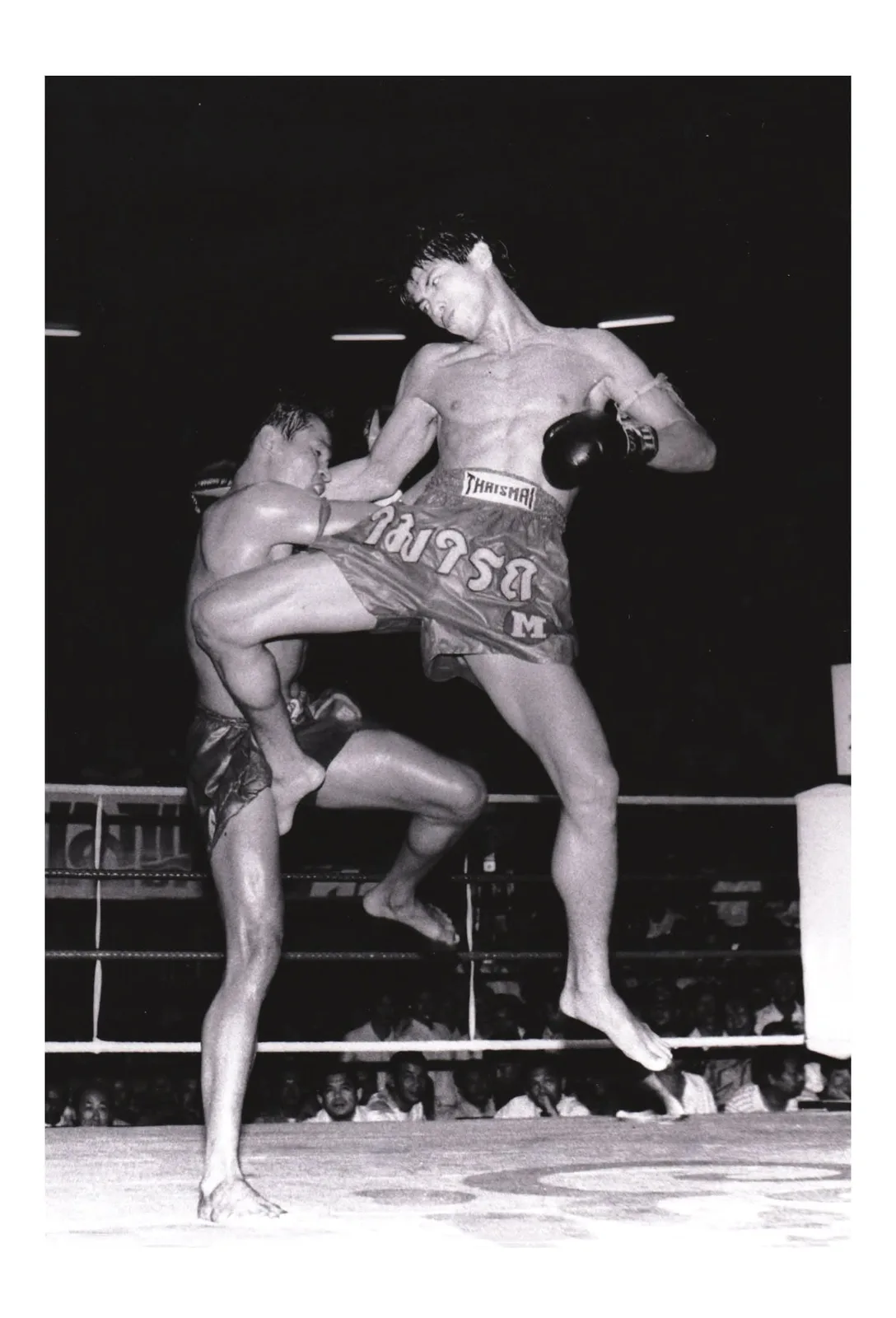
With the loss to “Lit’e” Samart on epical scale, Samart Prasarnmit hence missed his only chance of a rightful challenge at Dieselnoi, and that, in the author’s opinion, is one dead loss to history, as it would have been a hell of a battle of two best-matched fighters, in size, power and skills, of that era.
Thus, Samart, the unruly, mercurial character of a talented fighter, continued with his journey into 1984, when he kayoed the legendary Fanta at 2:20 in the first round, with a knee thrust to the groin. Fanta did not wish to play on, as his rival was four pounds overweight, so took the easy way out. This ridiculous (shameful) loss by Fanta, who was an international star, effectively put an end to talks for him to fight Samart Payakarun on Feb 9, RDN Stadium. Then, on May 3, the Dragon-Slayer stood in the way of rising Sakad Petchyindee (Fists of Pimai), and was knocked down in the second, an upset unacceptable to all. Duly disqualified by the referee, he was banished from the Bangkok stadiums for a year. By end of December, when he flew to fight Kaman in Hong Kong, he was in no condition at all, and the KO loss was no surprise.
He made a comeback in late 1985, beating Payap convincingly, to re-emerge as a qualified contender, but then, six days later, he turned up in Khonkaen (unknown to his manager) and was kayoed by Somsong (The Beast). Still, he outscored Payap in one of the most high-profiled TV broadcast battles (1986), where he had the feared kicker at bay, harnessed by a total of 104 spurning-kicks through five exciting rounds. Yet, his character being short on principle could not take him further, and after losing two fights to Payap, and a kayo by Krongsak, his career literally finished. His last fight, a KO loss in one round, in Ubol, was with Ayma P. Singdam.
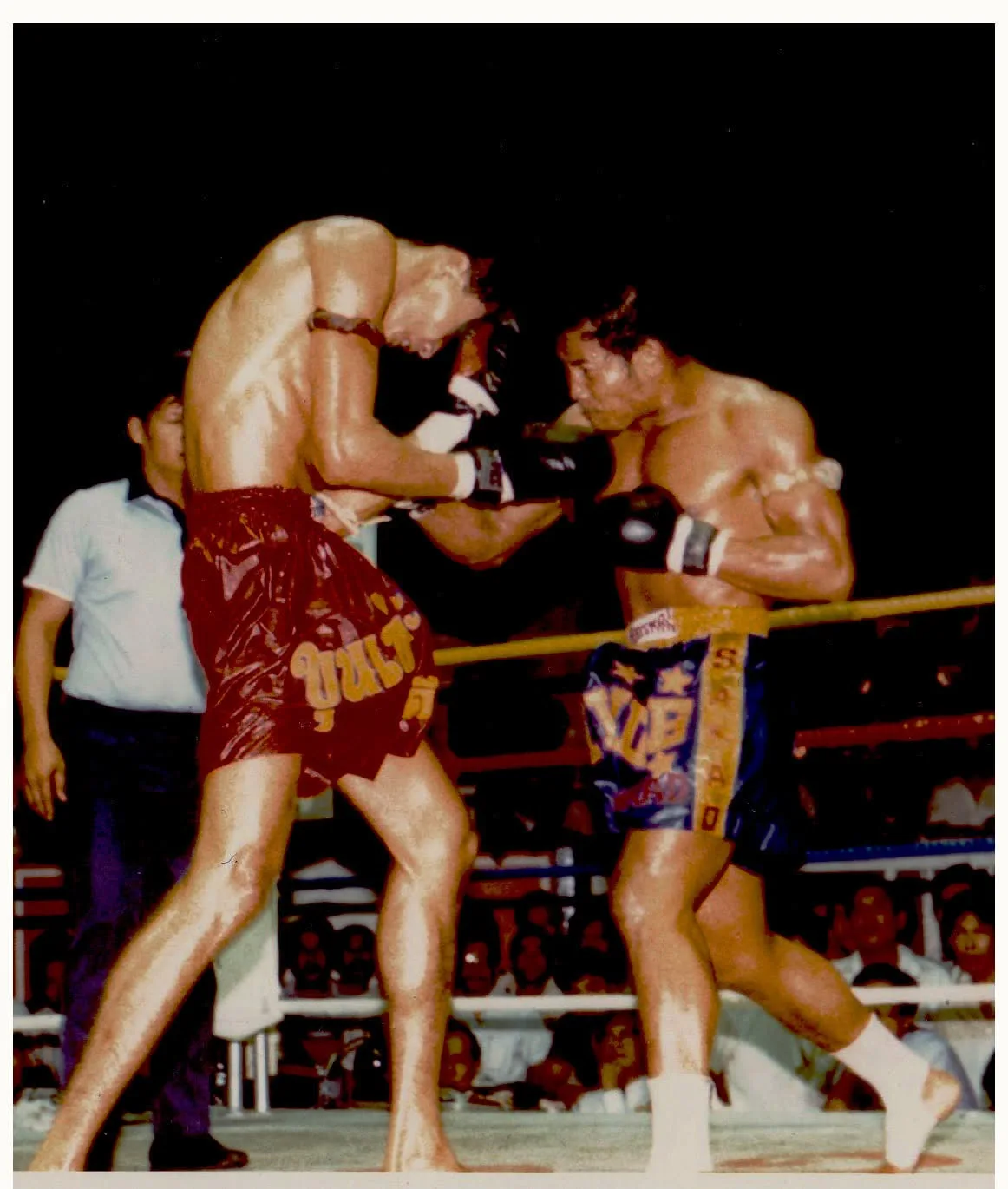
Payap – Best of Thailand, 1986
Payap the Great Kicker of the 80’s, finally had his time, in 1986, when he fought eight times, mostly at Rangsit TV Channel. He was never so busy, and his record (7-1) in this period, was amongst the best in the nation. He broke Sansatarn’s arm with kicks for a KO in 4 ; beat Rakchart on points for the RDN 147 crown, won DQ in 3 over Krongsak, Sisaket ; then outpointed Rakchart plus Ekapol ( in one-versus-two handicap format ), Samrong Stadium; a loss to Samart on points, Rangsit ; and then, he won the biggest title, “Four Demons” (Suek Si Yaksa), eliminating Khunpolnoi (74 kicks-pts 3) and Rakchart (10 kicks - KO 2) on the H.M. Queen’s Birthday Anniversary Program ( 8 August, 1986). Near the end of the year, he flew to Japan, and defeated again, his old rival Sakiyama,
He was the unofficial king of muaythai at this point, as Dieselnoi was in semi-retirement, and other camps were avoiding him like a plague. He was, in the author’s view, the defacto champion of Thailand, 1986. The key figure in a “One-vs-Two” fight was traditionally the sign of prestige of only the best boxer. In 1935, a champion in Ayutthaya did it. Three years later, Samarn Dilokvilas fought Thavan and Chaluay the same night in northern Thailand. In RDN era, the first to demonstrate this level of supremacy was Porsai (The Rogue), Charry (Black Shark) in Paris (1989), against two French fighters, and the last one was Saenchai, the Wizard of Mahasarakham (2009).
1987… after outpointing Samart easily in revenge, Payap found himself in one of the most outlandish contests in history, fighting Changpheuak with kicking forbidden on his part. The fight, on 24 April, Rangsit Stadium, was at 147 pounds. Barring the Great Kicker to fight with kicks, what a crazy joke ? But there was a wager involved, and as said, the driving force behind the nation’s noble fight sport was always gambling. The crunch was, once he kicked, disqualification (on a foul) would be enforced.
The cocky welterweight champion, for three rounds, took the fight to his younger rival, absorbing punches and kicks without flinching, to retaliate with a stiff straight right and knee rams - not exactly his usual style. At close quarters, by a hold and twist (oblique roll) flip, Changpheuak was tossed down, once and again, being handled like a toy. In round four, Payap was overly confident, moved in and out, taunting his foe, dancing around with hands down for fun. Then, involuntarily he teased his man with one kick, a right thrown half-flexed and uncharged… “Yud !” the referee halted the match, and called the move a foul. As the bemused Payap sank to the ring floor, the announcer declared the fight had ended, on a DQ in four.
Quite impossible, it so seemed, but as the saying goes, Anything could happen, this is Thailand!
After his lost to Kaman in Holland, Payap beat Samart the second time, and then lost on DQ 4 by Krongsak, in Sakhon Nakhon, and a one-round Kayo by Changpheuak signaled the end of his career.
(To be continued)