Copied with permission from Alex Tsui, Muay Thai historian: Alex Tsui's Facebook
The Unforgiving Kicks, part 19 of 19
The Unforgiving Kicks Part 19 - Into the Age of Conquests
29 October 2026 · by Alex Tsui
Written by Alex Tsui, a long-form series of articles on the great kickers of Muay Thai history
The 80s
The 70’s left many heartthrob memories in the kingdom’s boxing arenas. The serial challenges of the diverse fighting arts from foreign nations, exponents of Chinese Kungfu, Shantung Boxing, Cambodian Boxe Libre, Japan’s Kickboxing and karate, Korean Taekwondo, American Full-Contact, and highly-reputed Dutch Chakuriki fighters, have come to test the potency of muaythai. About 99 % of the matches ended in favour of the Thais - the majority on knockouts – with the last one percent taken up by the unique case of Toshio Fujiwara, Japan’s Last Samurai. The conflicts tended to bear testimony to the invincibility of Thai-style boxing over all other disciplines
Worthy of special mention was the audacity of Thom Harinck (Netherlands) in taking his Chakuriki fighter (Imro Van Hatten, Saisal Karakus, Ron Kuyt, Kenneth Ramkisoen, and Robbie Schumann) to compete against top Thai champions at LPN Stadium on 18 August, 1978. The events, which made great history in the evolution of muaythai, actually attracted a gate return of 1,210,200 baht. Another one, of tremendous media appeal, was the defeat of Toshio Fujiwara, by Narongnoi Kiatbandit, with 2,000,000 baht at stake between Thai/Japan stakeholder groups, on 12 February, 1979. The gate revenue of 994,000 baht (RDN) was recorded.
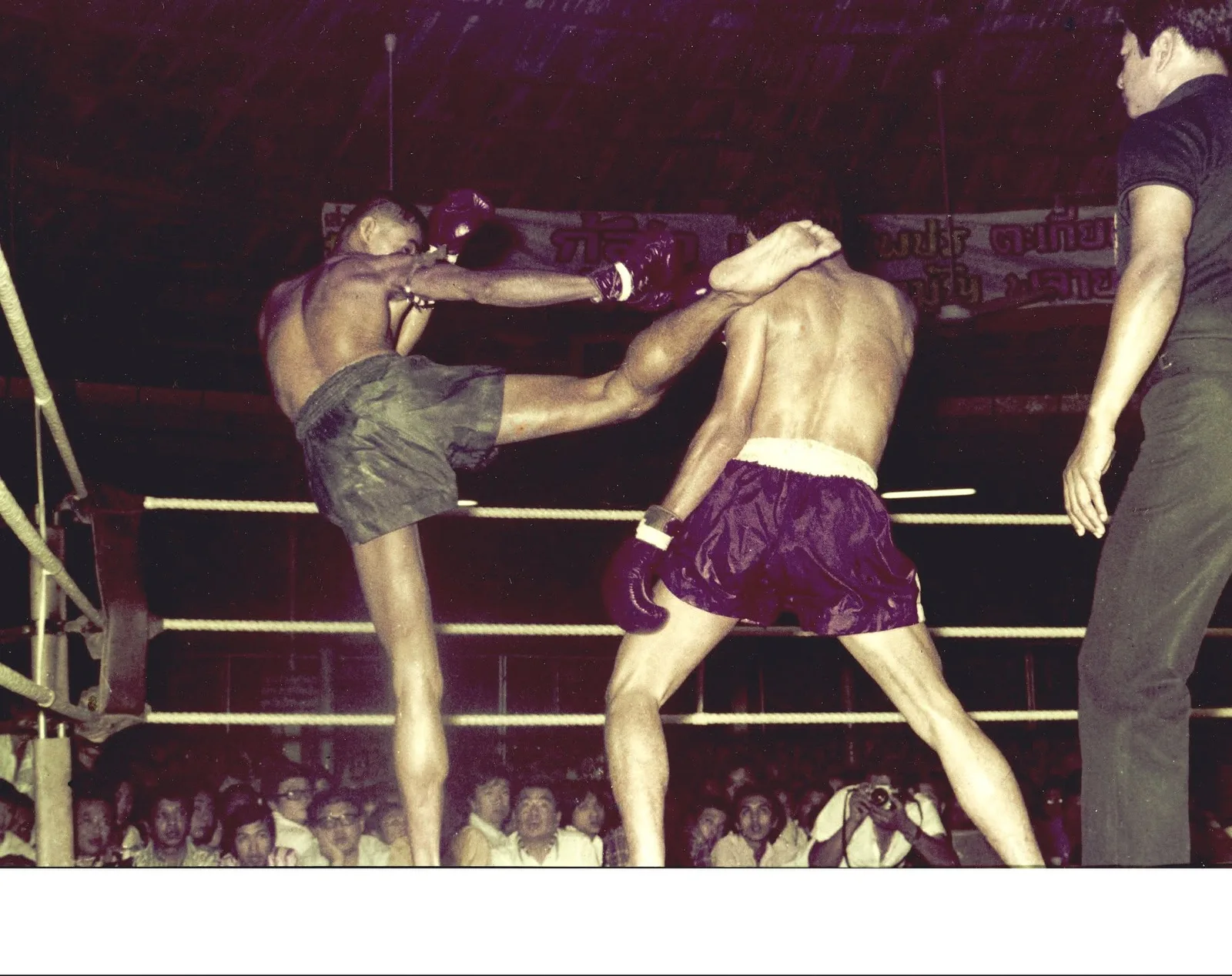
On the center stage of Yodmuaythai (Top Thai Boxer), Puth Lawlek left the scene after reigning for three years and six months. His successor, the tall, aggressive “Rogue” Porsai Sittiboonlert, was a knee-brawler of the first order, who earned a fearsome reputation for his electricity Pole-like knee strikes..
Demolition of three Japanese kickboxers, in one six-round match (one-v-three relay format), was truly the mark of ultimate supremacy in muaythai. The great Samarn Dilokvilas had done it before the war, against two notable rivals, and examples in the 80’s were Payap Premchai (Great Kicker), and Charry S. Vanit (Black Shark) in Paris. The last one was Namkhabuan Nongkipahuyut (Chameleon) against two alien fighters in Buriram, 1996.
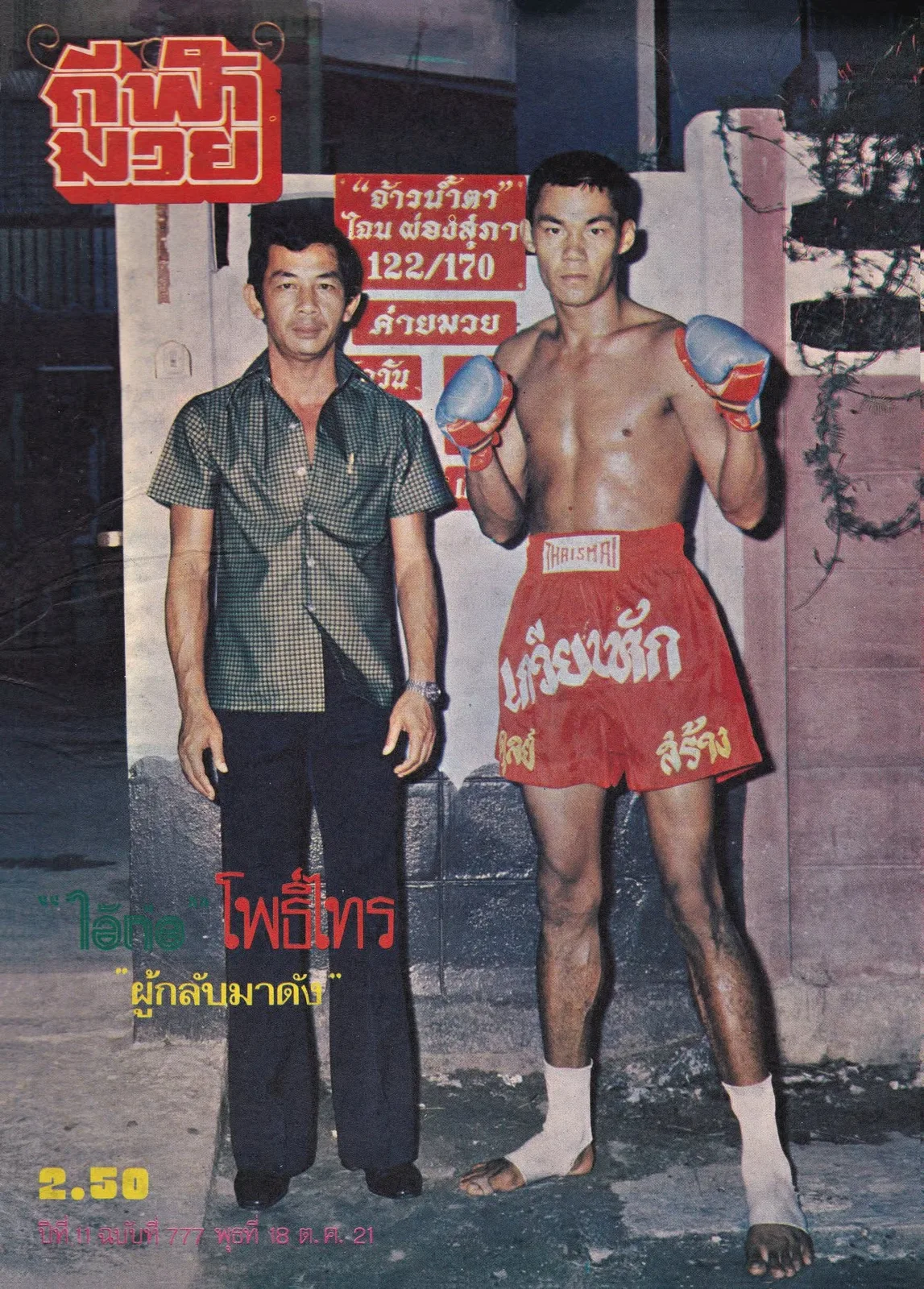
Porsai’s glory was however, short-lived, for after defeating Puth for the Yodmuaythai title in Fight of the Year 1977, he was disqualified and expeled in a match with Chitti Muangkhonkaen (Million-dollar Samlor Man). Though he managed to upset Puth again in a rematch in Hatyai, subsequent attempts to redeem the throne were all thwarted by the smaller, ageless Vicharnnoi Porntawee. One fight of special memory, seen by author in Lumpinee Stadium, was the clash of two Lords of the Knee – Porsai vs. Dieselnoi–height at 180 : 185, extremely rare amongst Thais, on 9 October, 1979, when the younger contender outslugged the former ace, on his path of ascension to the Yodmuaythai throne 1980.
Into the 1980’s muaythai was marked by a lone, continual line of conquests, in two opposite directions. As foreign advocates were coming to try their skills in Bangkok’s stadiums, Thai fighters are going overseas to various cities in Europe and America, for money and fame. One favorite spot during this epochal period was the then British Colony of Hong Kong (author’s home base).
In Europe, first we had expeditions of Japanese kick boxers to Holland twice. It was in these conquests that the Dutch stars Lucien Carbin, Andre brilleman, and Rob Kaman, emerged as the cream of the first generation in Europe’s kickboxing scene.
On June, 1982, Fanta Attapong (Petchmuangtrad) spearheaded a Thai team to fight in Paris against the Dutch Bulldog Brilleman, winning by stoppage with one hard left kick to the inside of the thigh, that disabled the Dutch legend, after dominating the opening round with well-time left kicks and close kneeing. The western media, especially in the United States, was inclined to be cynical of the legality of that kick, but the overall shock by the deadliness of Thai kicks, saw resonance across the world.
A French team was in Bangkok on 8 August, 1982 for a friendly exchange with the Thai Army Osotsapha stable at the TV channel, managed to collect two wins but three losses on kayo, including Patrick Brizon, a pioneer figure in French Kickboxing circle. The two winners, Franscois Kappeler (176) and Philip Cantamessi, fought again later, in June, 1983, at RDN Stadium and lost on points.
In January 1983, Sweden’s legal man with a heart in muaythai, Krister Berganhall, went to fight Kongdejnoi Lukbangprasoi in Cholburi.
Germany’s Klaus Handke, likewise, was so motivated as to travel to Thailand alone, to train and fight in 1988
As such events continued to roll in the never-ending path of history, author proposes to return to our great kickers of the 80’s. They include Jampathong na Nanthachai (RDN 118 champion), Nokvid Devy (5-title champion ), Payap premchai (RDN 147 champion), and Super Elephant Changpheuak Kiatsongrit (IMF 147 champion) – Heavyweight with the Golden Left.
Chameleon Tongue
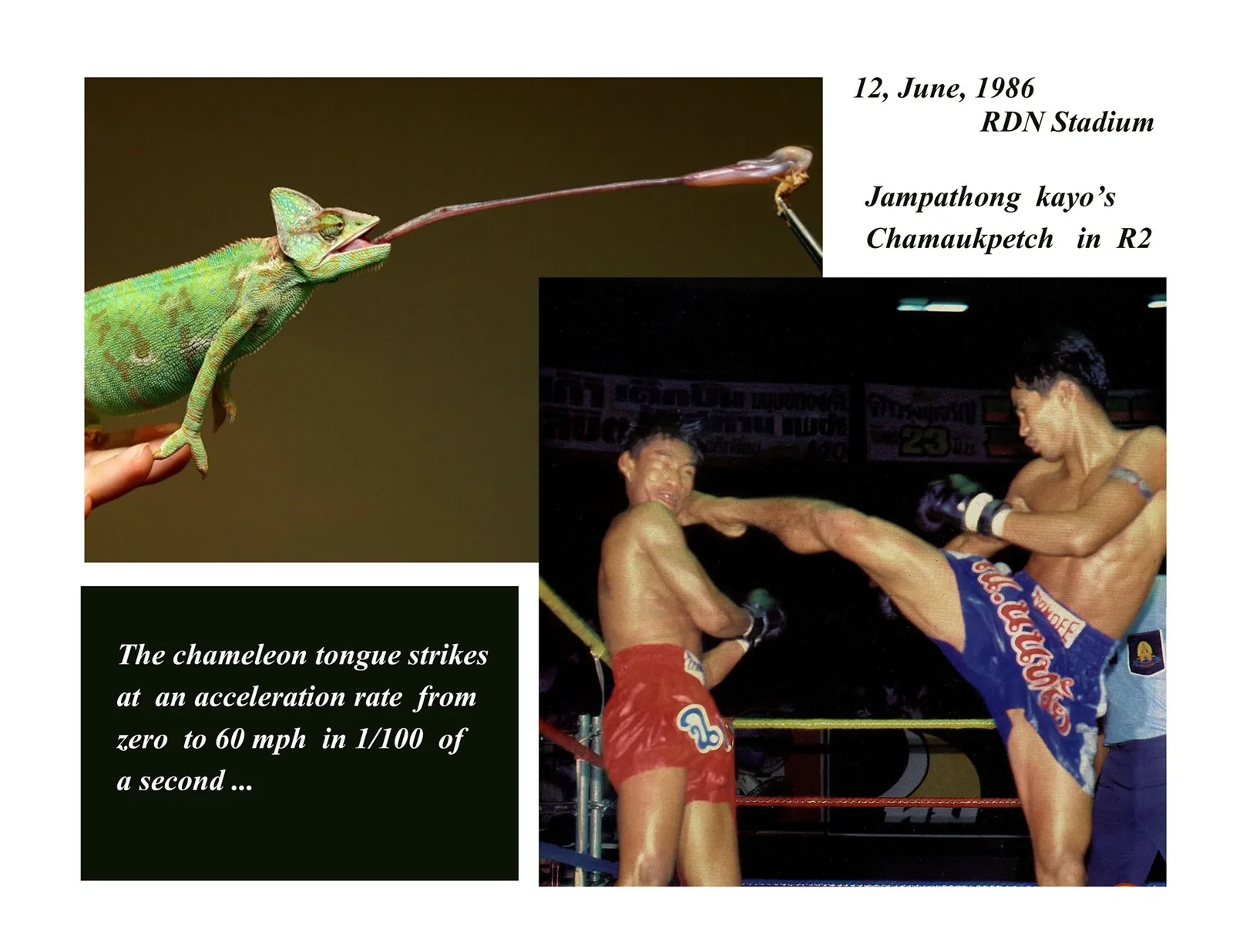
The fastest and most impressive striking arm in the animal world is the chameleon tongue : it accelerates from zero to 60 mph in 1/100th of a second when shooting out, over a distance of twice the length of the reptile’s body. The victim, as usual, is hit and caught before it could see anything at all.
That was precisely the experience with the kayo victims of Jampathong, the RDN bantamweight king, who prevailed over such great fighters as Saengtiennoi, Manasak, Saencherng, and Chamaukpetch, with his trademark high kicks, via the short route. He is known best for being the only fighter to have beaten the immortal Samart Payakarun, twice in his early days.
In one of his greatest feats, his knocked out Chamaukpetch (Computer Knees) with one right kick to the jaw, with the speed that matched the chameleon’s tongue, in the second round. The match drew 1,206,480 baht for RDN Stadium.
Payap Premchai
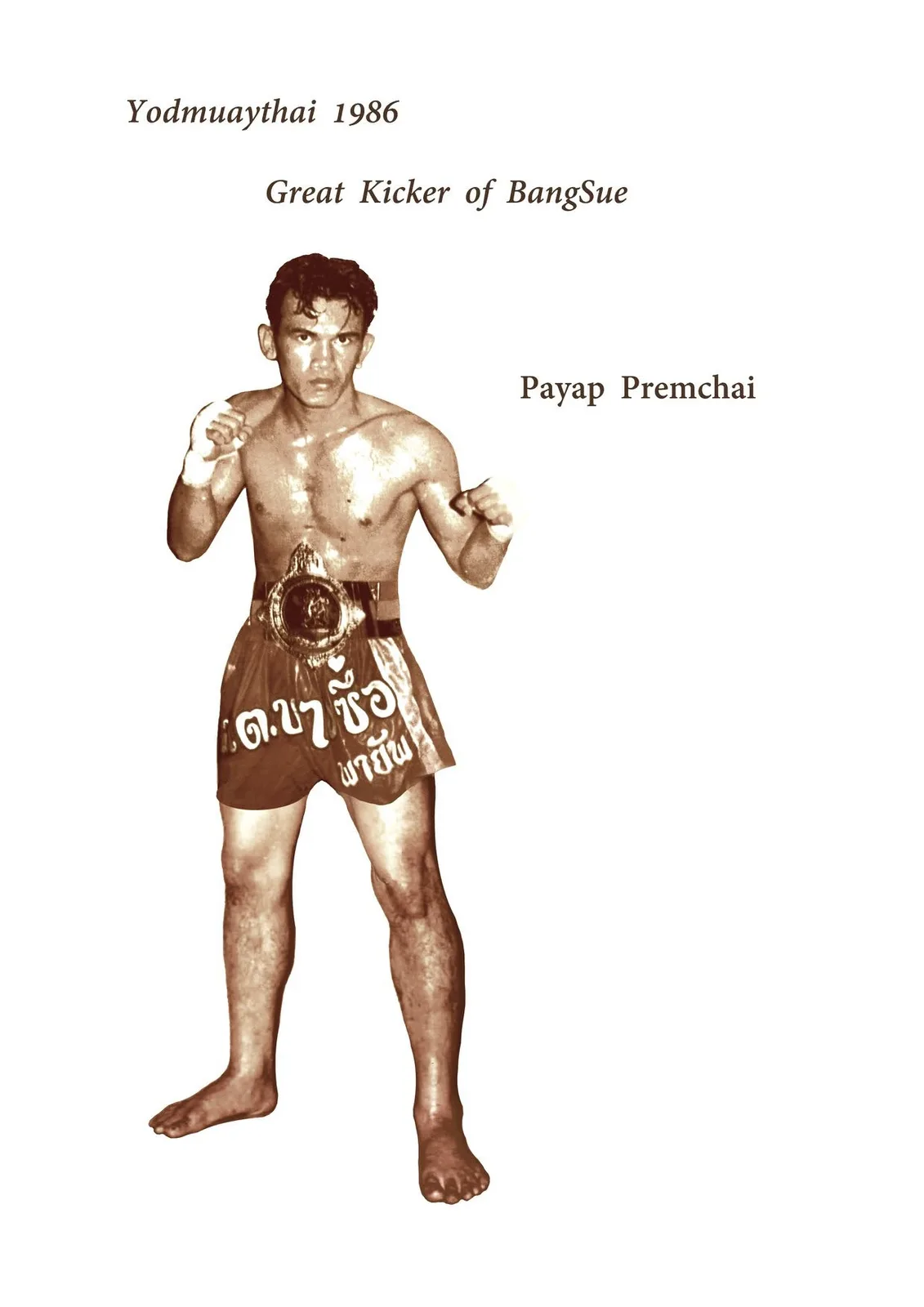
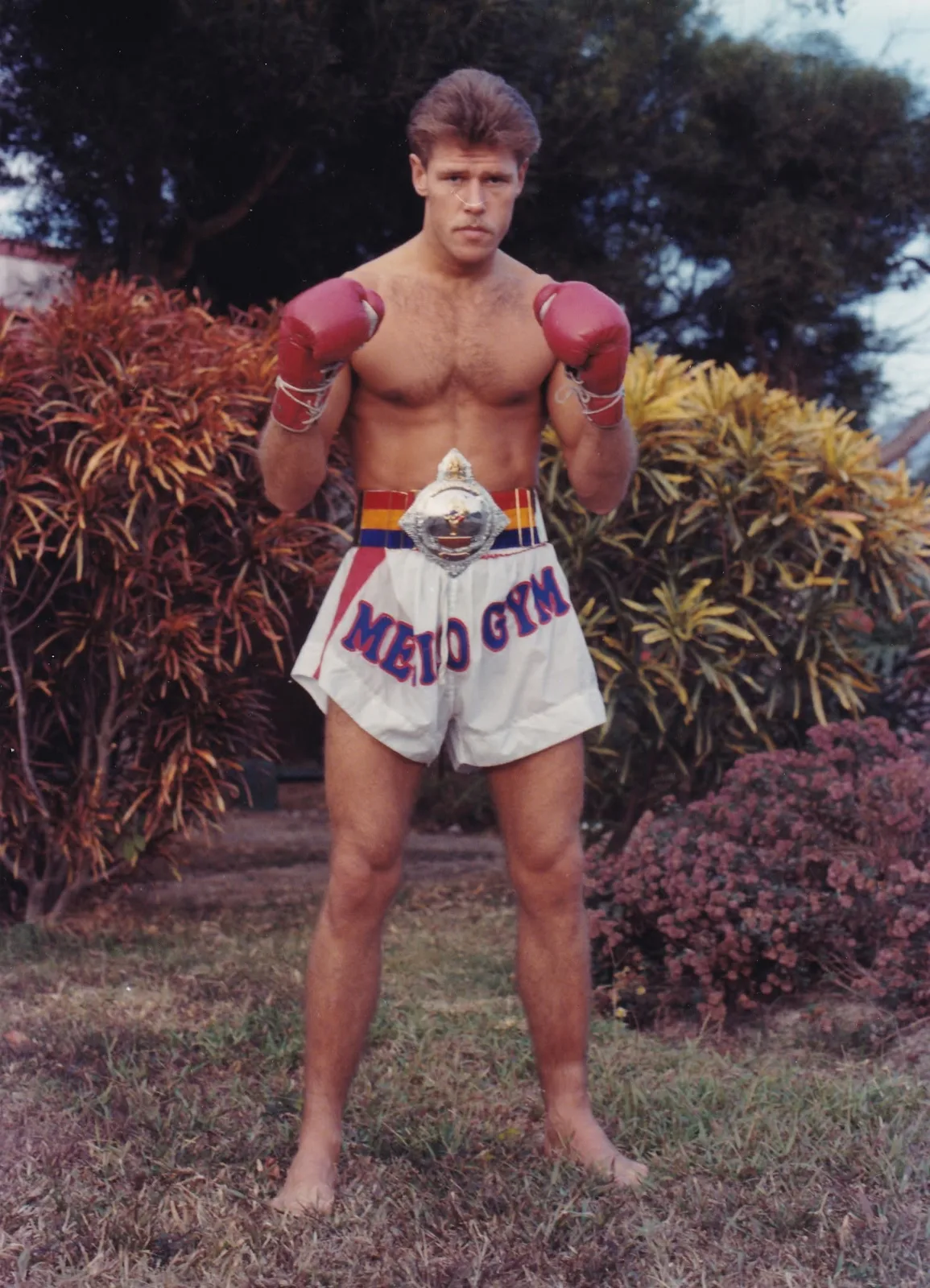
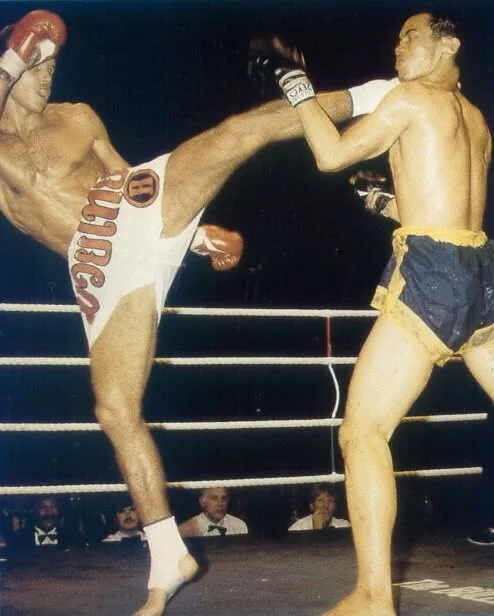
One most memorable kickers of the 80’s was Payap Premchai, the “Great Kicker of Bang Sue”. On his rise in 1980, he had dispatched such notables as Sakad ( Fists of Pimai), Seeprae (ex lightweight champion), Pudpardnoi (Kid with the Golden Shin), and Somsong (The Beast), with only one significant points loss to Rakchart…… but his advance was unstoppable, for he went on to campaign overseas, registering impressive victories in Hong Kong and Europe, and in between tours, eliminating Densiam (TKO5), Rakchart (TKO5), Petchsiam (TKO3 ), Porsai (former YMT) and again, Somsong (December 4, 1981)
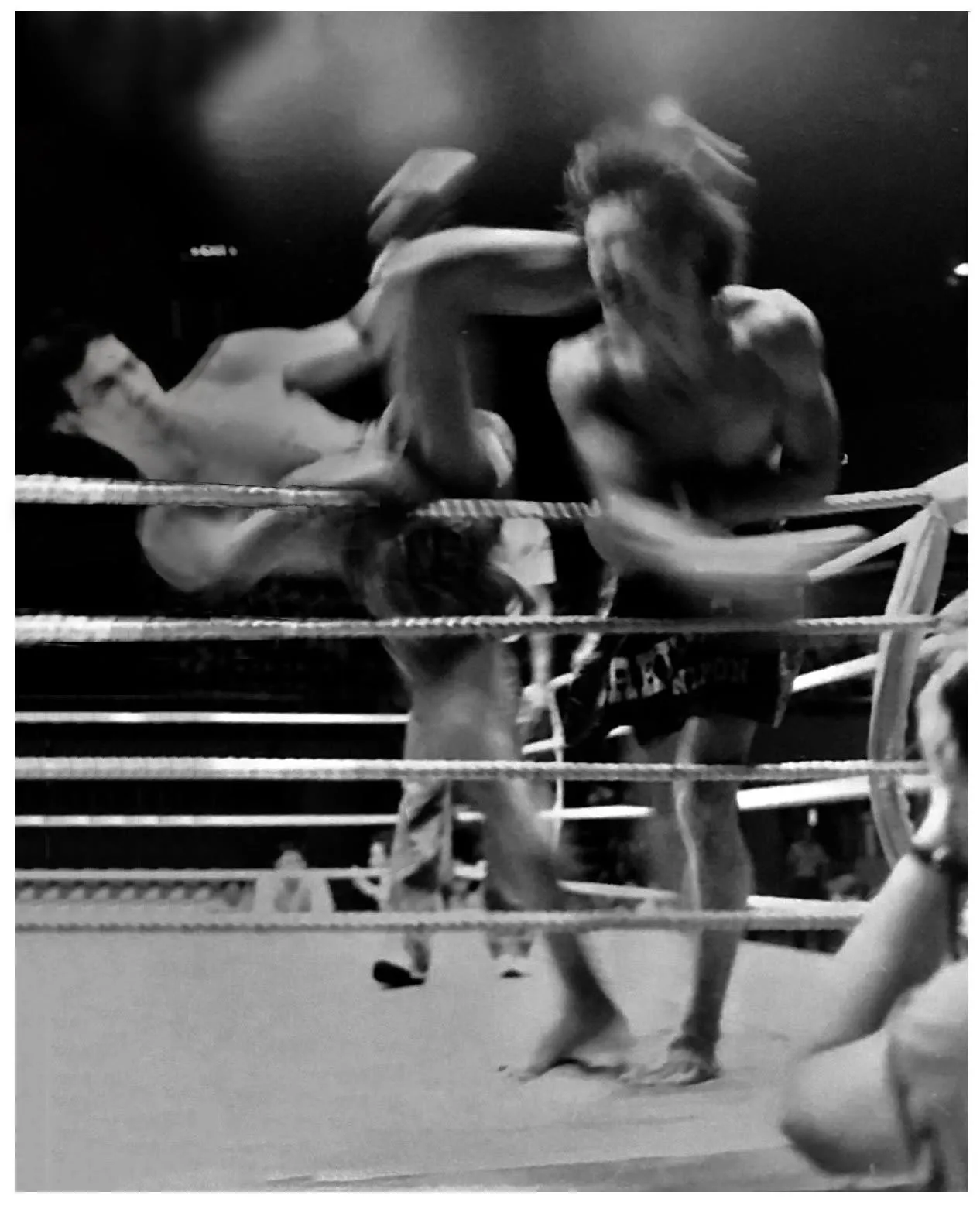
In 1983, Payap fought one most sensational match of his career in Hong Kong, when he progressively disabled the stubborn Sakiyama of Japan, to a climax that saw the frenzied 3,000 –strong crowd mostly standing on their feet, to bear witness to that one final finisher left to the head, sending the Japanese samurai to instant oblivion. That, in the author’s opinion, was his best kick, ever landed.
January, 1984, Eden Hall, Amsterdam
The sight of Payap Premchai dancing, in disco fashion, swinging and wriggling in mid-ring, cocky and smiley, flushed in spotlight but suddenly veiled in brief darkness showered by glittering lights overhead ; and then with local hero, Rob Kaman, jig walking, snake-hipped, shuffled out to meet his destiny, all against the noisy background pop music being played, was simply electrifying. It was two modern-day warriors, locked in one small time-space, to share the trial of fortune and resolve, in an almost fiction-like gladiatoral combat.
Dutch fans were still awed by the brutal vision of Peter Van Os literally howling in pain against the ring post, being counted out by the referee, after taking 30 hard kicks on the body and right arm from the Thai executioner. That was Payap’s first appearance in the Netherlands, how unforgettable. But this time, instead of skating and waltzing around the ring like before, to fire tactical kicks for the demolition effort, he withstood, in the first two rounds, at close-quarter, the full blast of the Dutchman’s power punching – straights, hooks, and uppercuts – plus kicks, in the earlier rounds. The disadvantage in size had seemingly no effect on him (Payap was basically a welterweight blown up to 70 kg.) Thereafter, it was an all-out slugfest, with neither side prepared to yield an inch. Still, the bigger Dutch Adonis (72 kg.) was vehemently pushed around, and stung repeatedly by the Thai’s straight right. By the last round, Kaman, while backing off, let fly one beauty of a left kick to the head …. It was explosion in the eyes and hearts of the local fans inside the packed hall ! Payap persisted in his wild aggression until the end. The decision of the judges went to Kaman, though many felt it should have gone the other way.
The two gladiators met again, on 31 May, 1987, at contract weight 77 kg. The Thai (73 kg) was not ill-prepared, and was equally game, yet lacking managerial control and adequate acclimatization after a long flight, his performance suffered, thus losing a knockout in the fifth. For Kaman, it was his 24th kayo victory in 33 fights. And again, It was the same left hook to the body, that he had used to dismantle Samart Prasarnmit in Hong Kong, 1984, that did it (witnessed by author).
In the 90’s, author was in one of the stadiums where he bumped into Payap. Rather surprisingly, the first thing he proffered was a plea of innocence : “I did not lose to Kaman,” he said !
To be honest, I do have my view on most big fights, but this time, I do not feel the loss was grotesquely unfair after all. It was a close contest with both sides drawn to their extreme. Payap’s abrupt proclamation, however, reflected he was so resolute in his attempt to win that epic battle, and just could not accept the negative verdict delivered. He must be regretful for life, that he could have defeated the biggest name in the world of muaythai kickboxing at the time.
(To be continued)