Copied with permission from Alex Tsui, Muay Thai historian: Alex Tsui's Facebook
The Unforgiving Kicks, part 18 of 18
The Unforgiving Kicks Part 18 - Confrontation
29 October 2026 · by Alex Tsui
Written by Alex Tsui, a long-form series of articles on the great kickers of Muay Thai history
Moments of truth
The great Apidej having faded away, the attractions in the game are new faces.This was the 70’s, the age of Lumpinee Chief Col. Thongtherm Popsuk and legendary promoter “Old Master” (Kru Thao) Chana Sarpkaew, whose Taharn-Ek (Supreme Force) programme was the prime event had the most glittering star. It was also the golden age of two luminaries - Yodmuaythai Put Lorlek (versatile stylist) and Pudpadnoi Worawut (legendary kicker)...
It was also the age the Muaythai fighters were facing continuous challenges from varying combat stylists from outside the kingdom – Japan, Hong Kong, Singapore, Malaysia, Cambodia, Taiwan, United States etc.
Like the primeval tribal wars in the old days of mankind, the rule of nature was the code of survival - The conqueror lives, and the vanquished could only elect to capitulate, or die…
Master Spurner
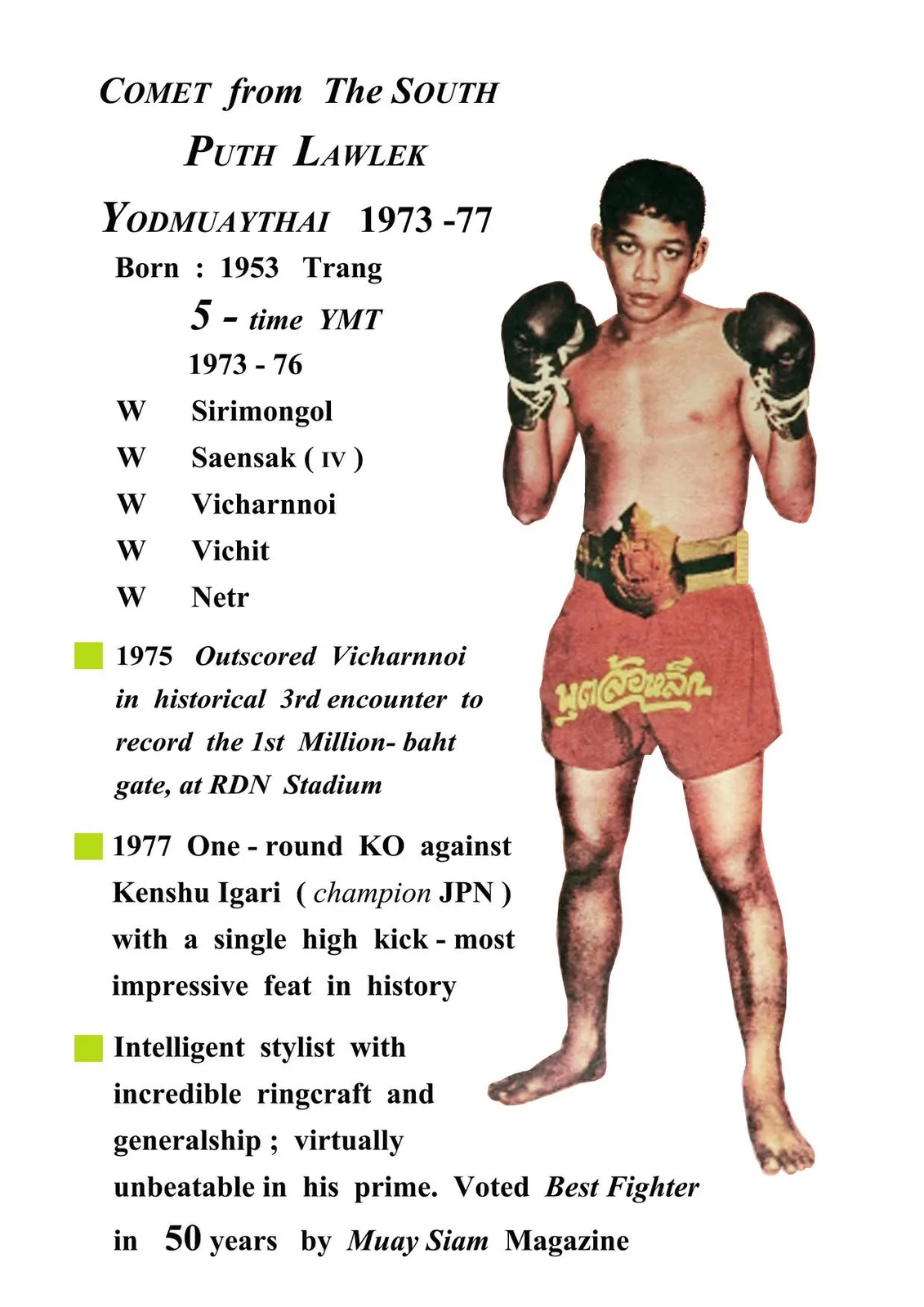
The top star Put was simply extraordinary, for his forte lies in his razor- sharp reflexes and ape-like body agility. Though naturally a super lightweight (below 140), but he could tackle opponents 20 pounds heavier, using fascinating skills, unparalleled speed and superb intelligence. He was not, per se, a strong kicker by definition, but he could, and did, outkick or outsmart many a reputable kicker (Chuchai, David, and Mehmud). Wisdom aside, he had the speed of featherweights, an advantage that allows him to hit first, repeatedly, and dashed out to safety well before his heavier opponent could counter or retaliate. That distinct advantage renders him invincible. On the character study, he compliments flying kicks with a very fine style of spurning – offensive footwork of exceptional dexterity. He was able to lift his fore foot, poised to attack, by stamping at his foe up to five times in each sortie, or for defense as a jarring agent to maintain his safety zone. A master spurner, he could spurn off a kick, or flex a kick into spurning...
Theatre of Kickers
The best kickers in this period were : Pudpadnoi (Kid with the Golden Shin), Chuchai (Army 147lb. title), Songkiat (TBC world 160 lb. champion), David (The Elephant - top welterweight), and Prayuth (Conqueror of Benny the Jet)…
From the innumerable great battles fought in this period, two cases of high kick knockout stood out for being amongst the most theatrical In history.
The Thailand Boxing Council world championships (more appropriately, Oriental) 1972, at Hua Mark Indoor Stadium, was a two-day showdown featuring the best of Thailand and Japan. Amongst the seven titles at stake, only one was captured by Japanese, Shima, after a great battle. But the fight which made real history was the bitter war between American Raymond Edler (Japan’s middleweight kickboxing champion, an ex. U.S. Marine originally from Tri-Cities, Washington), and Thai Songkiat Kiatpracharaj, a stocky kicker from Mahasarakham, northeastern Thailand.
Edler, who had two previous fights against Thai contenders in Bangkok, was riding on a 14-0 winning streak in Japan this time.
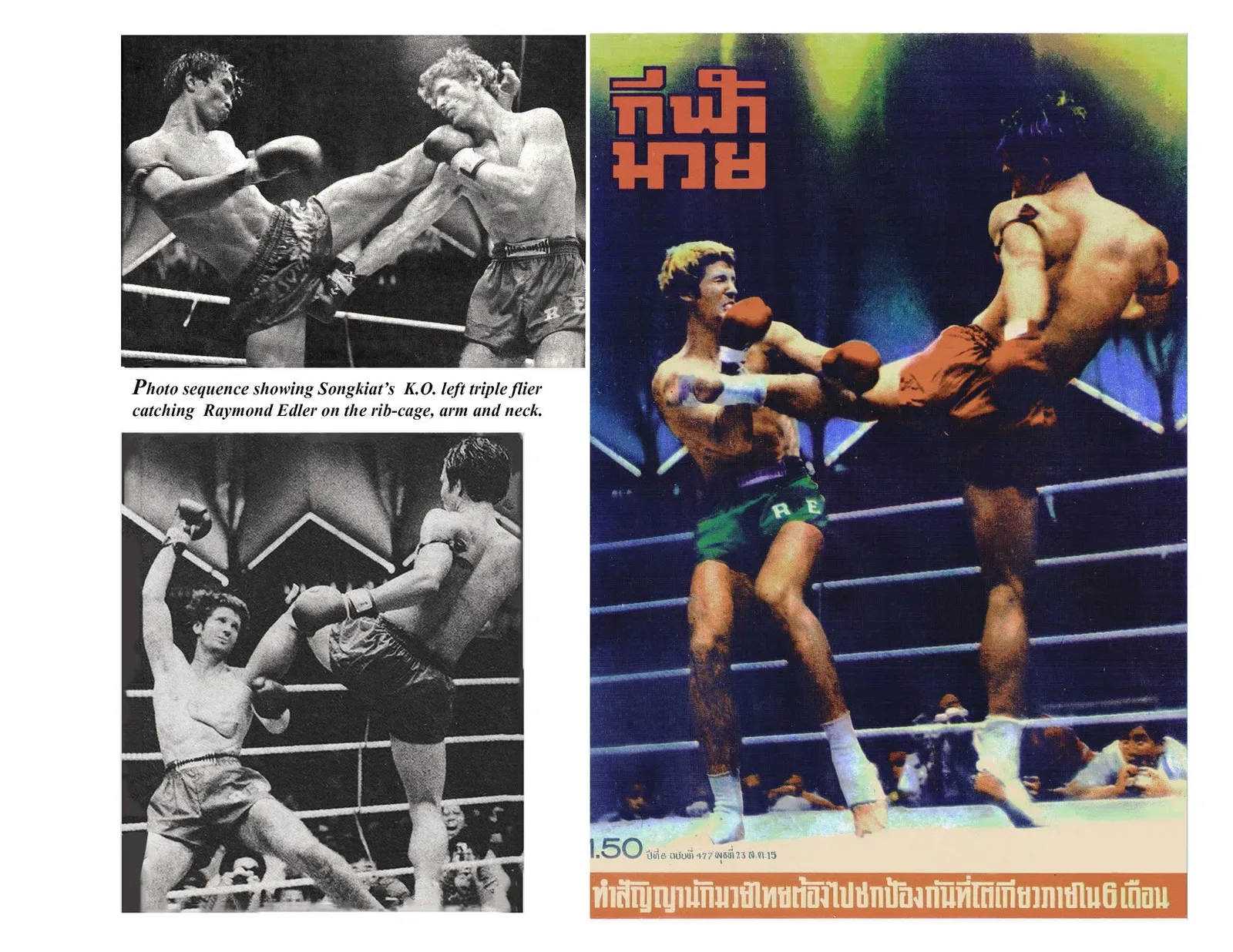
In the high-profile battle, both the 1.90 m-tall “Blue-eyed Kickboxer”, and his local rival, were cautious initially, being wary of each other’s hitting power. The dance of death lasted two rounds …..From the third onwards, Edler, confidently playing the hunter, attacking hard at long range with his one-two combo, and long leg kicks, had the smaller Thai (1.71) constantly on the retreat, to avoid his blows. But the Thai, though troubled, was sharp in his command, retaliating with dynamic kicks that shook the American, but only temporarily.
By the fourth, when Edler visibly slowed down, a series of three strong left kicks from the Thai, one each on the right arm and rib-cage, followed by a lightning-fast third to the head, fell the blonde American like a log. It was a terrific drama, in which the hunter became the hunted, with the Thai turning around what was a losing game to claim winner by a stunning knockout.
The picturesque sequence producing the upset, was remarked by local media critics, as the ultimate combo in muaythai technology, having the potential in reversing the fate of a fighter, from an underdog in dire trouble of peril, to suddenly triumph over the superior adversary.
Highest model of Muaythai art
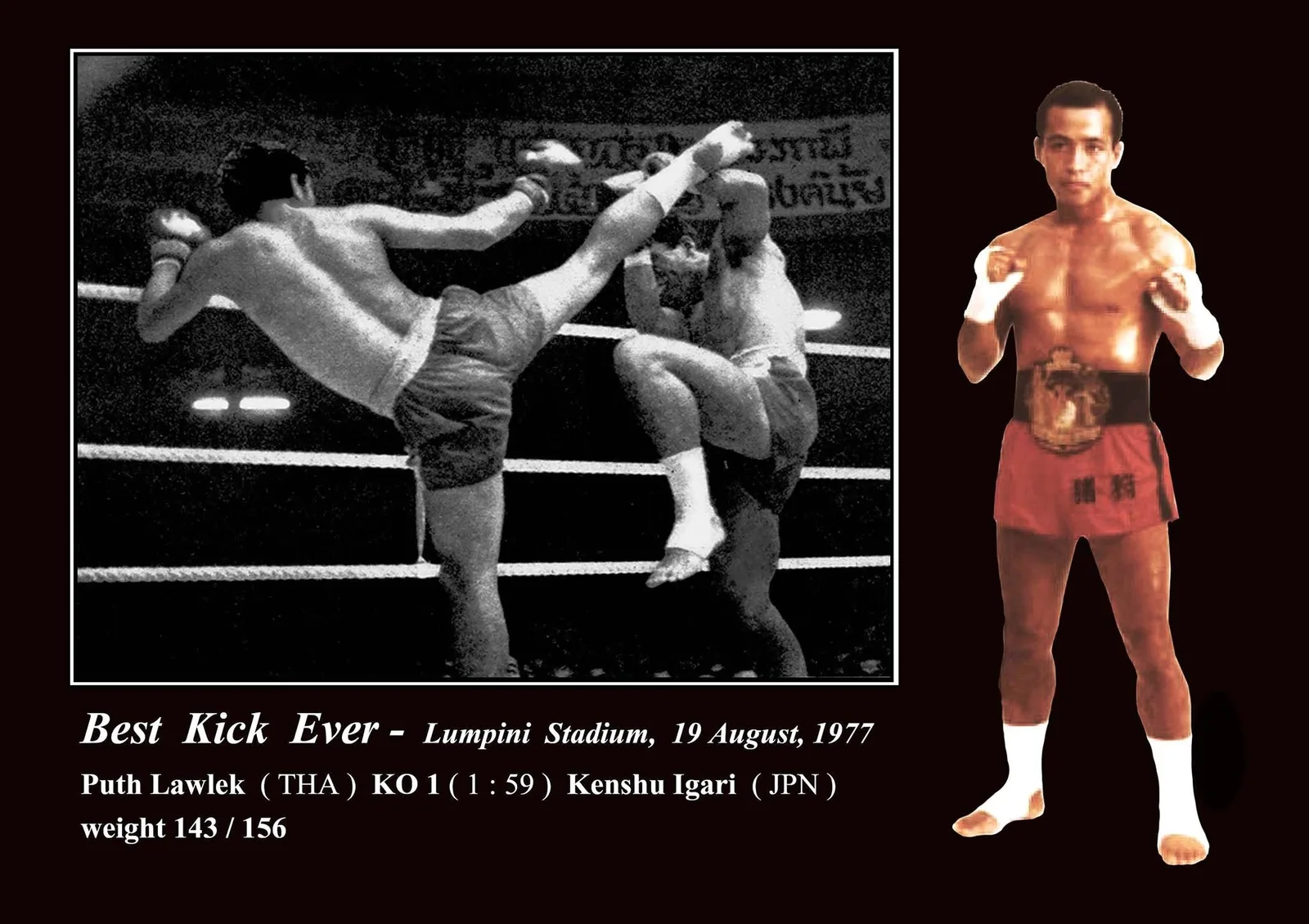
The second most defining kick of the decade was, without question, the one that precipitated the one-round knockout of Japanese mortal-puncher Kenshu Igari (156), by former top boxer Put Lorlek (143). The Japanese, a sturdy samurai carrying three recent kayo wins against Thai first-line exponents (Satarnfah, Songkiat, and Pichit), was seeking a place in history for destroying one of the most famous and all-round Thai technicians of this age. In contrast, the Thai had lost three bouts in a row, and this fight, with the honor of the national art at stake, was one he (as admitted to the author) could not afford to lose.
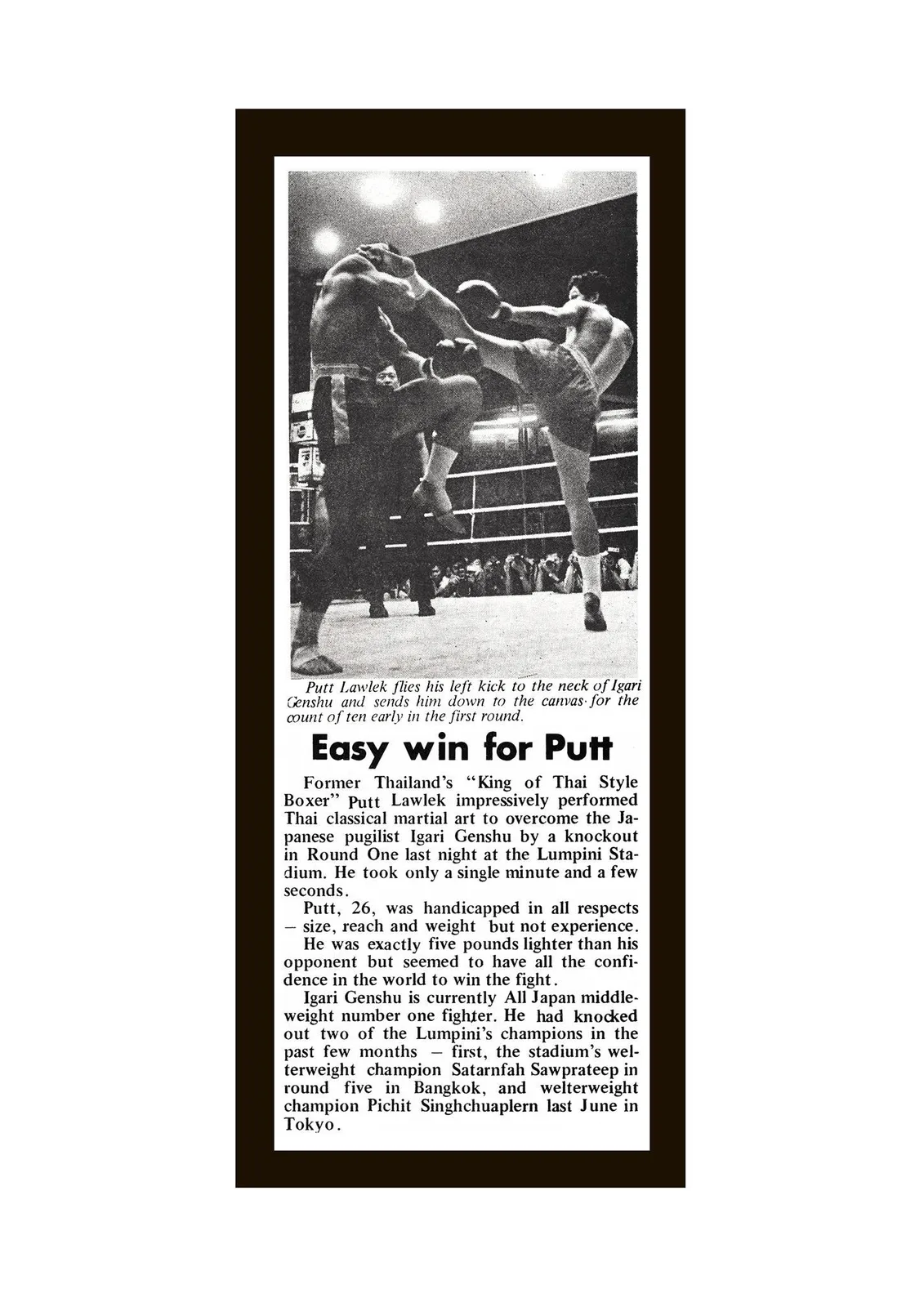
19 August, 1977, Lumpinee Stadium was packed by fans anxious to see the outcome of the historical challenge, bringing in roughly 400,000 baht to the coffers of the army-owned venue. Puth, the great evasionist, used only 1:59 of the opening round, moving, spurning and swerving, to neutralize the head-on fists-feet aggression of the Japanese, and then, Bhok, one phantom-like high left – delivered with elegance, almost effortlessly and in superb timing – caught Igari behind his ear, literally dragging him to the ground. The sensational knockout, which happened right in front of the author’s eyes, prompted a huge ovation inside the arena.
The victim, Igari, wrote in his autobiography, with utmost respect for the Thai, that he never saw the kick coming ; it was just instant blackout. Lumpinee Stadium Chief, Col. Thongtherm Popsuk, described the kick as absolutely the highest model of muaythai art – the man had been in the heartland of muaythai for 40 years, and no expert could cast any doubt in the truth of his words.
Mid-Summer Nightmare
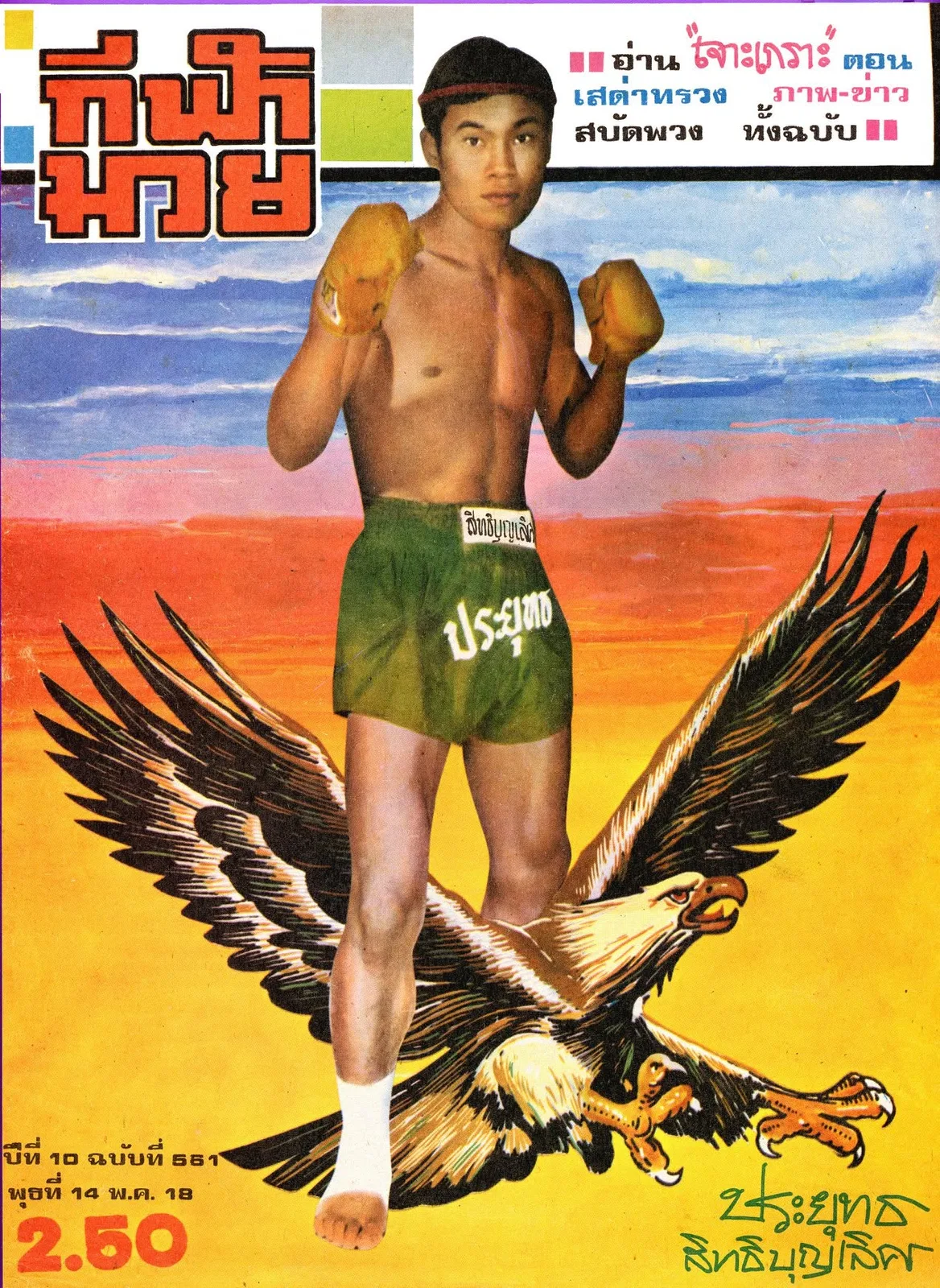
Prayuth Srisomphob - only fighter to have conquered Benny the Jet, 1978.
One last episode of the 70’s that must not be overlooked was the “Mid-Summer Nightmare” at Tokyo’s Denen Coliseum, promoted by none other than the legendary Karate-kickboxing guru Kenji Kurosaki (originally Kyokushinkai) on 2 August, 1978. In the multi-discipline programme, Thai kicker Prayuth Srisomphob defeated American WKA kickboxing superstar Benny Urquidez in six rounds (Kickboxing rules) at 142 pounds. The famous karate-turned free style artist, widely idolized for personifying the martial concepts of the immortal Bruce Lee, was completely outkicked and punished by close-in kneeing assaults, thus losing by a wide margin for the first time in his career. A return match, scheduled on October 31, for the welterweight title of the New Martial Arts Federation (Kakutogi), ended controversially, with the American failing to compete after weighing-in, apparently due to a medical problem. Prayuth, who had never won an official title at home, was thereby awarded the world title on a walk-over... But the mishap dealt a severe blow to the image and credibility of the new promotional body.
Kurosaki’s master plan was to stage a “dream match” for his prize student, Fujiwara, to face Urquidez, once the American had gone past the Thai. However, since the events transpired, the showdown was never realized. Later, in Tokyo, Prayuth was humbled by Fujiwara, on a points verdict.
(To be continued)