Copied with permission from Alex Tsui, Muay Thai historian: Alex Tsui's Facebook
The Unforgiving Kicks, part 10 of 10
The Unforgiving Kicks Part X
26 October 2026 · by Alex Tsui
Written by Alex Tsui, a long-form series of articles on the great kickers of Muay Thai history
The Black Bull of the Royal Thai Army
Before leaving the sentimental 50’s when the Kingdom of Thailand still retained much of its old-fashioned Siamese ways, the author feels obliged to recall, at least briefly, the unique ventures of one army boxer, named Pansak Vittichai, whose only credentials after a ten-year career was the lightweight title in the Royal Thai Army, yet his deeds to the credit of muaythai could outweigh the achievements of many a famous champion crowned by either of the main stadia in Bangkok.
This is a composite story of his extraordinary career, unique even by Thai standards, sourced by several reports including one personal interview by the Boxing Weekly (Thai) in the late 70's. .
Born in the northeastern province of Buriram, he joined the regional military formation and began boxing at age 17. After winning many fights in the northeast, he was brought to Bangkok and soon became a sensation…
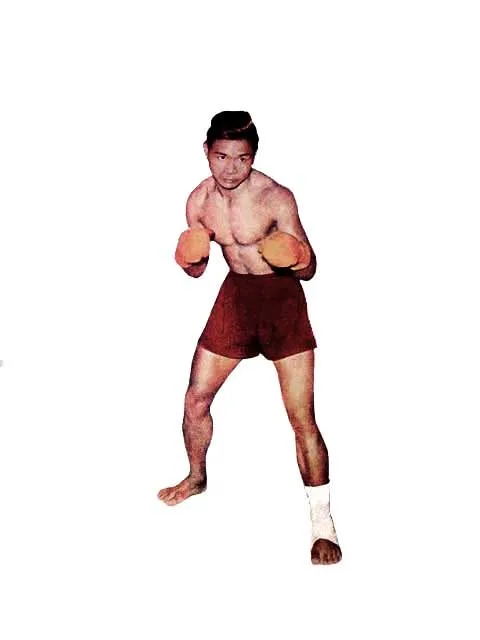
Pansak Vittichai, muaythai legend of the 50's.
The quiet, unsociable introvert, had nothing in his heart except fighting, and it was the only thing he could do best.
He lost only once in 22 fights at RDN since 1954, and then failed in his first title bid in the RDN 135-pound division. He had six fights with champion Surasak Barbos (Head-hunter), won four, lost and drew one each. He lost three times to new lightweight champion Sompongs Samanchand (The Shark), yet won the last (4th) encounter.
He soldiered on, to challenge Srisawat Thiamprasit for the LPN 147 muaythai crown, and later, Oamsap Laemfapha, the RDN boxing title (12R), both without success. His undertakings on switching to pro boxing, advanced till he was ranked in Asia, under the OBF (Oriental) system, but he never reached international stardom.
It did seem that good fortune chose to avoid the determined fighter every time he had a crack at a major championship title, but he persisted.
Chance Duel with Savate in Paris
Then came June 1957, together with Somkiat Kiatmuangyom (pro boxer), the duo flew to Paris with manager Thavit Chaktikavanijaya (高金龍), on a pro boxing tour. However, failure to obtain a permit from the French boxing authority left the party in limbo, and the fighters resorting to do shows in night clubs. Once, they were arranged to fight against local Savate experts in a club basement, before a restricted audience. History was made when Pansak kayoed his foe, a 1.80 m- tall French master, with lethal kneeing after landing a few punishing low kicks in the first heat.
Pansak, a resolute fighter with a solid right punch and hard kicks, was a dangerous brawler. Though not strictly a premier kicker, he did score two most remarkable kicks in his career. First, his R2 knockout of Pinit KIngpetch (1955) with a high left, and secondly, his epical defeat of top karate fighter Kengo Nishihara of Japan, also bear testimony to the potent effect of his unrelenting kicking, the final one of such being a high left to the head that fell the man.
Muaythai vs. Karate - the first encounter
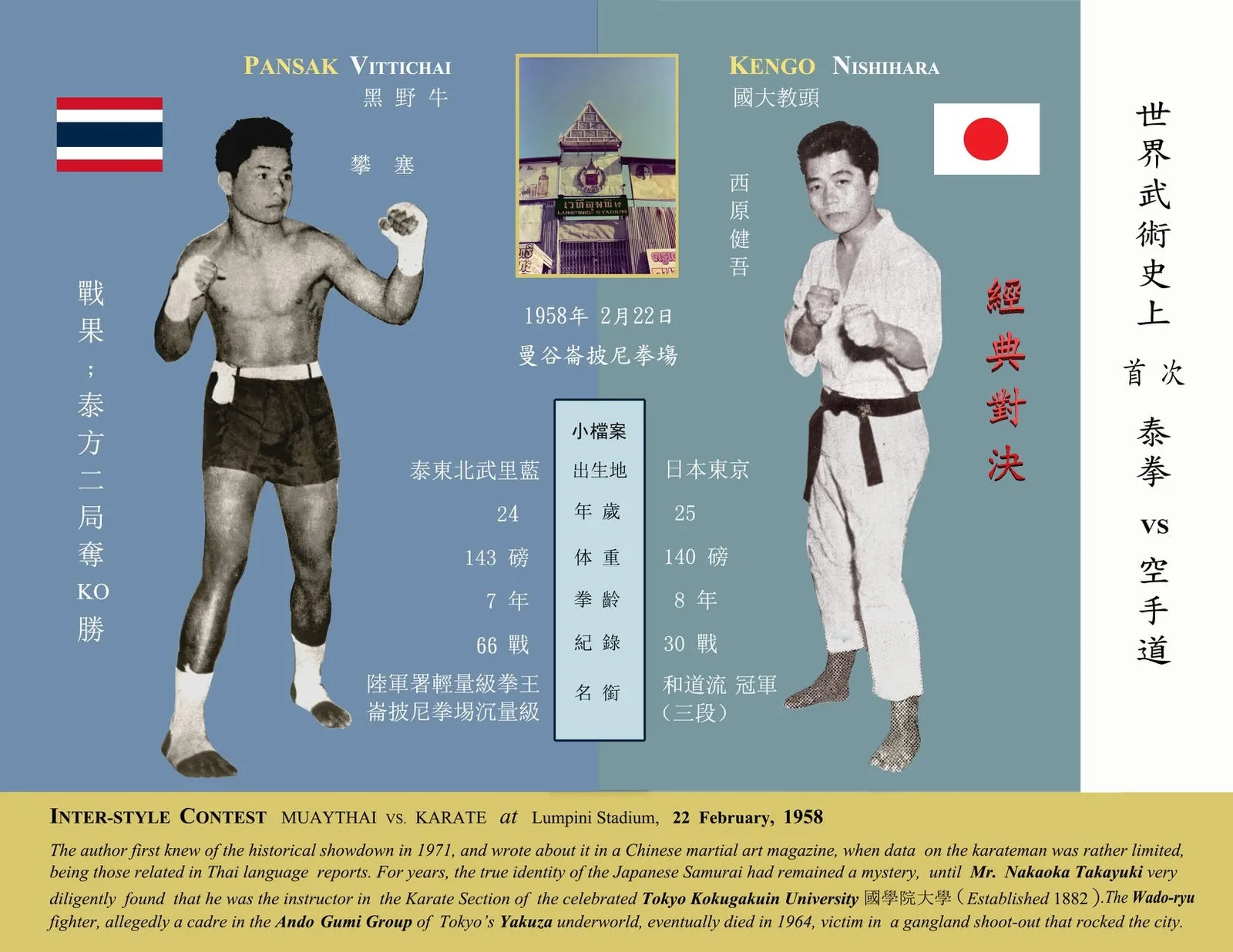
Souvenir Profile of the fighters composed by author.after having established the full story behind the landmark conflict. The author's quest for the true story actually began in 1971.
On the day 22 February, 1958, Pansak (then ranked 2nd in LPN) took on the challenge of Japan’s premier Wado-ryu Karate instructor Kengo Nishihara (3rd Dan) from the elitous Tokyo Kokugakuin University東京國學院大學, in a free-style match.
In a pre-fight interview, a Thai media report emphasized that the Japanese, supremely confident in his deadly art, “could kill any man within five minutes”.
Lumpinee Stadium was packed to capacity on the day of the fight, as fans were keen to see which of the Oriental fighting arts would prevail in a free-for-all situation. Could the national combat science of Thailand stand up to the deadly knife-hand of a true karate expert ? Or does the toughest trained karateman have an answer to the brutal, unrelenting flying kicks and devastating knees of a proven Thai fighter ? The questions are extremely provoking……
As it turned out, it was absolute annihilation by the Black Bull, wherein the proud karate instructor dramatically succumbed to a knockout in the second round.
The news report in the local Chinese media had this story :
“With prior mutual consent, the match was to be decided only on knockout or T.K.O., with no decision on scoring.
The attire of the two sides was their normal gear in competition – Pansak, in Thai-style trunks with gloves, and the Japanese, bare-knuckles wearing the Judo Gi.
The Japanese began from a static posture, as the Thai quickly launched a determined assault, with repeated hard kicks, at his legs, causing the former to tumble and fall. This happened time and again, with the Japanese visibly hurt. Midway in the round, twice Nishihara attempted a prototype karate jump-kick, but was deftly avoided by the Thai, who just cut him down with low kicks. The karateman’s charges were all futile. When the bell rang, the Japanese was having difficulty standing.
In round two, Pansak continued with the onslaught, blasting the visitor with leg kicks. On the latter retaliating with a kick, a timely sweeping counter by the Thai had him crashing down from mid-air. As the tempo of the fight increased, a perfect high kick connected on the head of the samurai, followed by a knee thrust to the chin, and ending with an elbow socker on his nape. Down the badly battered Japanese fell, and the referee duly counted him out. The fight was over within five minutes of action…..
The Japanese manager was agonized by the brutal slaughter, as he did attempt to call a stop to the melee, before the coup de grace was applied, but no one bothered.
On the way to the dressing room, Nishihara, his both legs badly bruised, could hardly walk, and later vomited for the painful damage sustained. He said to the press that Thai boxing was truly awesome, and admitted he was unable to withstand it.”
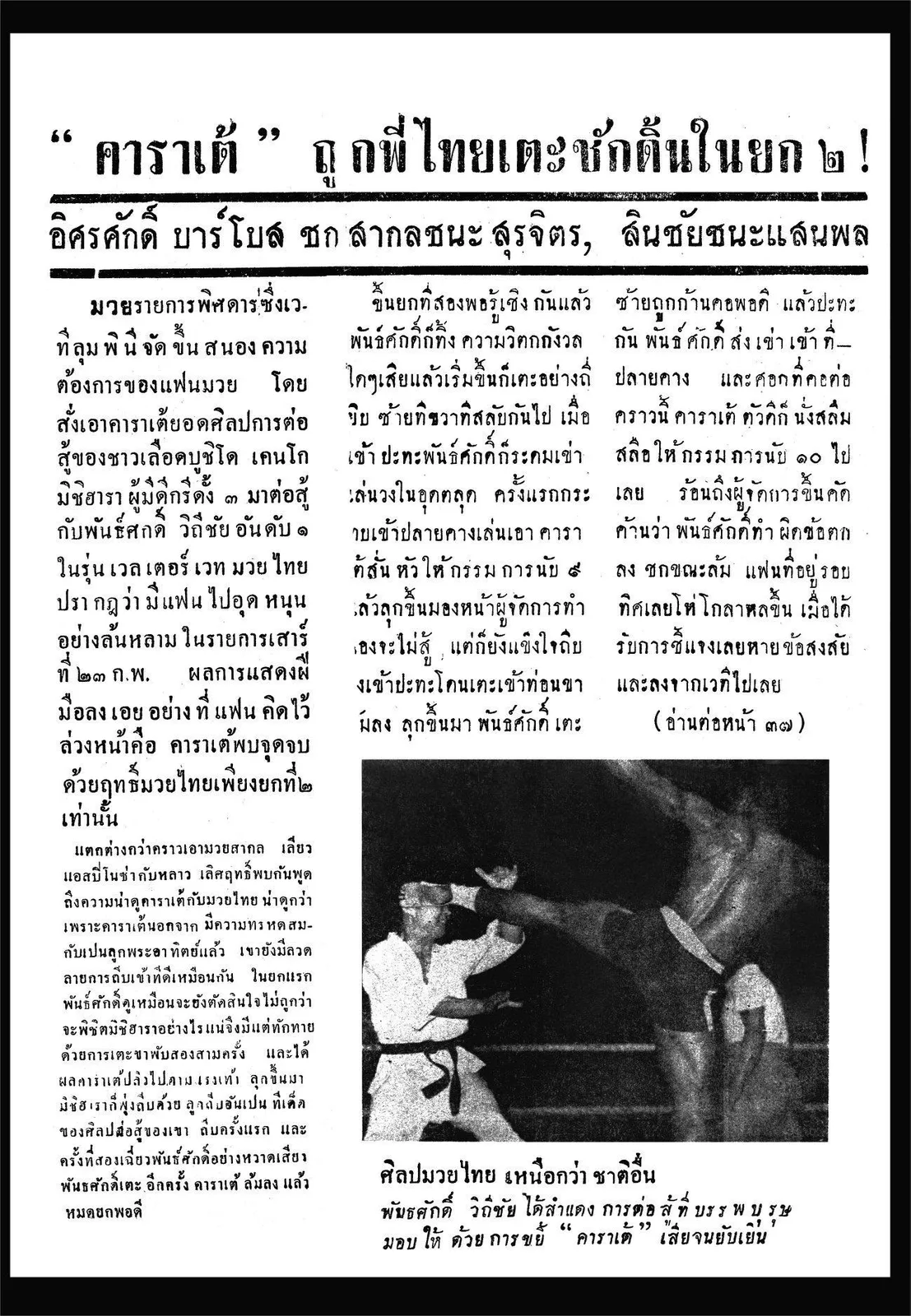
Thai boxing magazine report on the fight, date quoted therein was February 23, whilst the correct date was 22.
The clashes with French Savate and Japanese karate, albeit each occurring in rather bizarre circumstances, and for vastly disparate reasons, were historically, landmark events which marked the earliest cross-discipline exchanges of such kinds, and are deemed symbolic in the evolution path of Muay Thai.
To the Thai fighter, it was nothing more than two days’ work, and the significance of the impact of these ventures never quite occurred to him. But it has taken the author some 40 years to re-discover the full truth behind the Nishihara story.
The daunting samurai was in fact a senior cadre of the Ando-Gumi Yakuza group. He died in 1964 (then 4th Dan expert) in the streets of Tokyo, the victim of a gangland violent shootout. The incident, which shocked the city, culminated in the disintegration of the group. (Information by courtesy of author’s associate Nakaoka Takayuki of Japan).
(To be continued)