Copied with permission from Alex Tsui, Muay Thai historian: Alex Tsui's Facebook
The Unforgiving Kicks, part 1 of 10
The Unforgiving Kicks - Over The Ages Part I
26 October 2026 · by Alex Tsui
Written by Alex Tsui, a long-form series of articles on the great kickers of Muay Thai history
The trademark of a proficient muaythai boxer is a pair of legs that can kill. 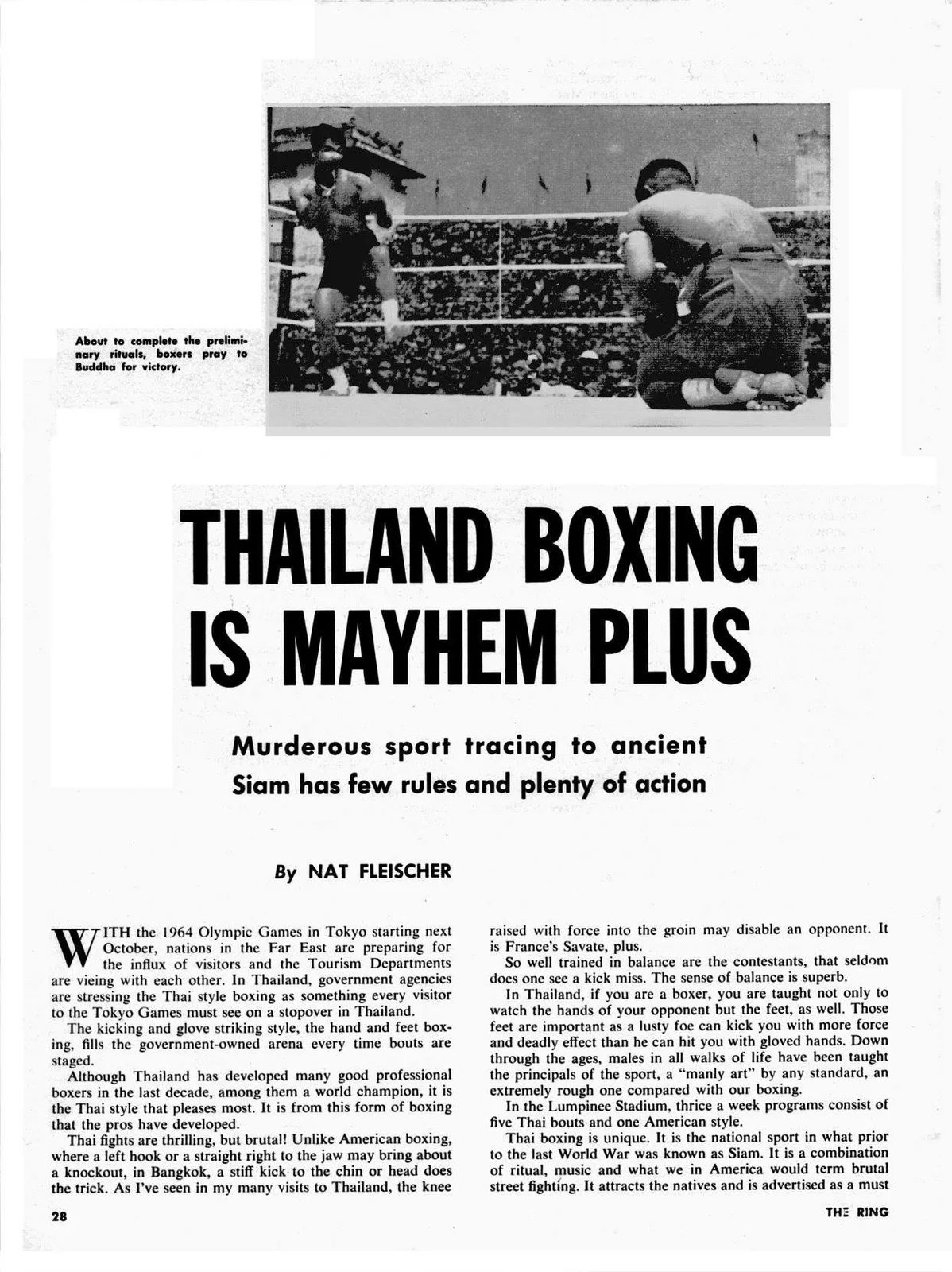
First report on muaythai in The Ring Magazine, 1960.
Kicking (Dhet in Thai), is an age-old science to the Thai people, and, as the old saying goes : Thai kids could kick even before they can run. While the compliment might be a little emphatic, it nonetheless epitomizes the natural inclination of the Thai people to kick in physical combat. Before the kind of footwork in muaythai has become popular in the western world, the title brand had been known as Siamese boxing (暹羅拳), or “Siamese Foot” (暹羅腳), which aptly signifies its unique emphasis on thorough usage of the lower limbs. That reference to use of foot by the Siamese was first noted in a feature article in the Washington Post, dated 30 April, 1916, by the most eminent journalist, New York’s Robert Edgren, on Pugilistic Sports, where the following description was carried :
“In Siam, the natives have a fighting style almost exactly like Savate. They kick with the foot drawing the toes up, and with heel, also using knee when convenient. They have great tournaments and annual championships. They have practiced this art and held their contests for hundreds of years.” (adopted from data courtesy of David Leonardo Barcena of Spain)
Siamese boxing has been given various names over the years, from “Siamese Kicking”( attributed by local citizens right after two Thai students on government sponsorship, Cheur Chaksuraks and Wanlop Thanasiri, did an exhibition at the Withrow Institute, Sydney, Australia, 1926) ; subsequent titles varies from the negative “Oriental dirty fighting” (American media ) ; “Legal Bloodbath” (western travelogue, 1957), “Barbaric Sport of a Humble Race”, and “Thailand Boxing is Mayhem Plus” ( Nat Fleischer of The Ring Boxing Magazine, 1960), to the kinder ones, like “Thai Boxing sport of a King” (Tony Dale in Swasdee, May 1974 issue). Its name in the past was “Thai Boxing” and “Thai-style Boxing” (The Bangkok Post, and Thai media before 1973) …… Nowadays, it is universally muaythai. Luminous instances of prodigious use of the feet to triumph in the ring are practically uncountable in the history of this incredible culture. What the author proposes to relate here are the most classic cases which have been noted or recorded by Thai critics, of triumphant feats in the ring – labeled the Unforgiving kicks of muaythai. In the epical period of Suan Kularb College boxing, 1921-22, the best exponents of the kicking style were from Nakorn Ratchasima, or Muay Korat, represented by Thab Jomkor and Yang Harntalay. The former, nicknamed “Divine Kicker” was so fast and dynamic with his footwork, that he could “balance a stick in the air” ( first recorded by Donn F. Draeger in Asian Fighting Arts - written with Robert W. Smith, Tuttle, 1969) , and the latter, stylized “Ferocious Tiger of the Highlands”, became a heroic figure for two landmark victories over Chinese martial art experts in that era.
Kick of the Century I
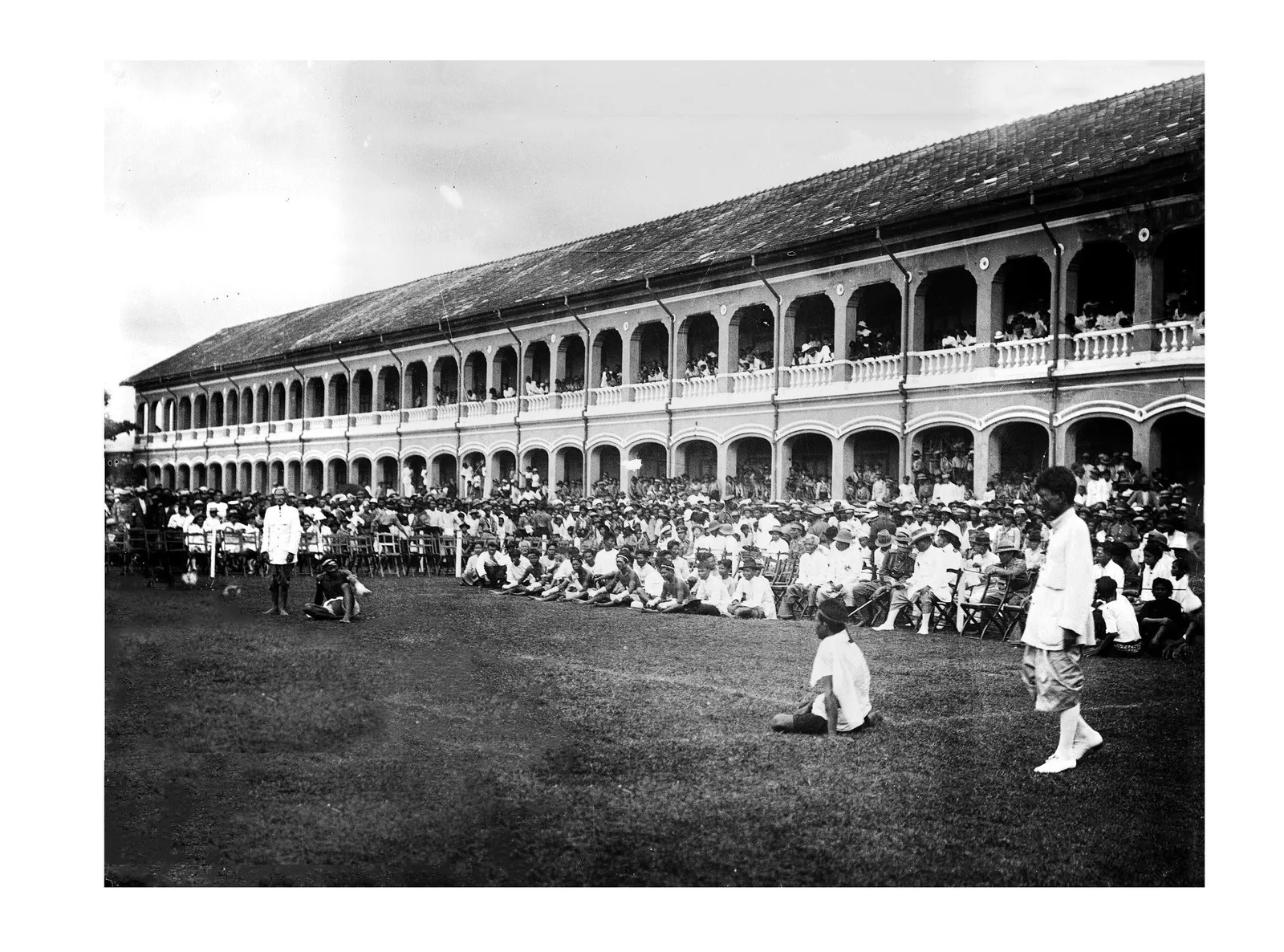
First day in Suan Kularb charity boxing - a ring was erected in the week after, due to proceedings being interrupted by overenthusiastic crowds on the first day.
The time is the second month of the historical Wild Tiger (Scouts) Corps boxing programme, instituted by the royal decree of H.M. King Rama VI, to raise funds for the purchase of rifles in aid of the Corps. The venue, Bangkok’s Suan Kularb School ground ( 玫瑰園大學校 ), where an open ring is erected for contests to involve the best talents from the provinces as well as those from and around the capital city region. It is the inauguration of professional muaythai in an organized way of a scale unseen in the past.
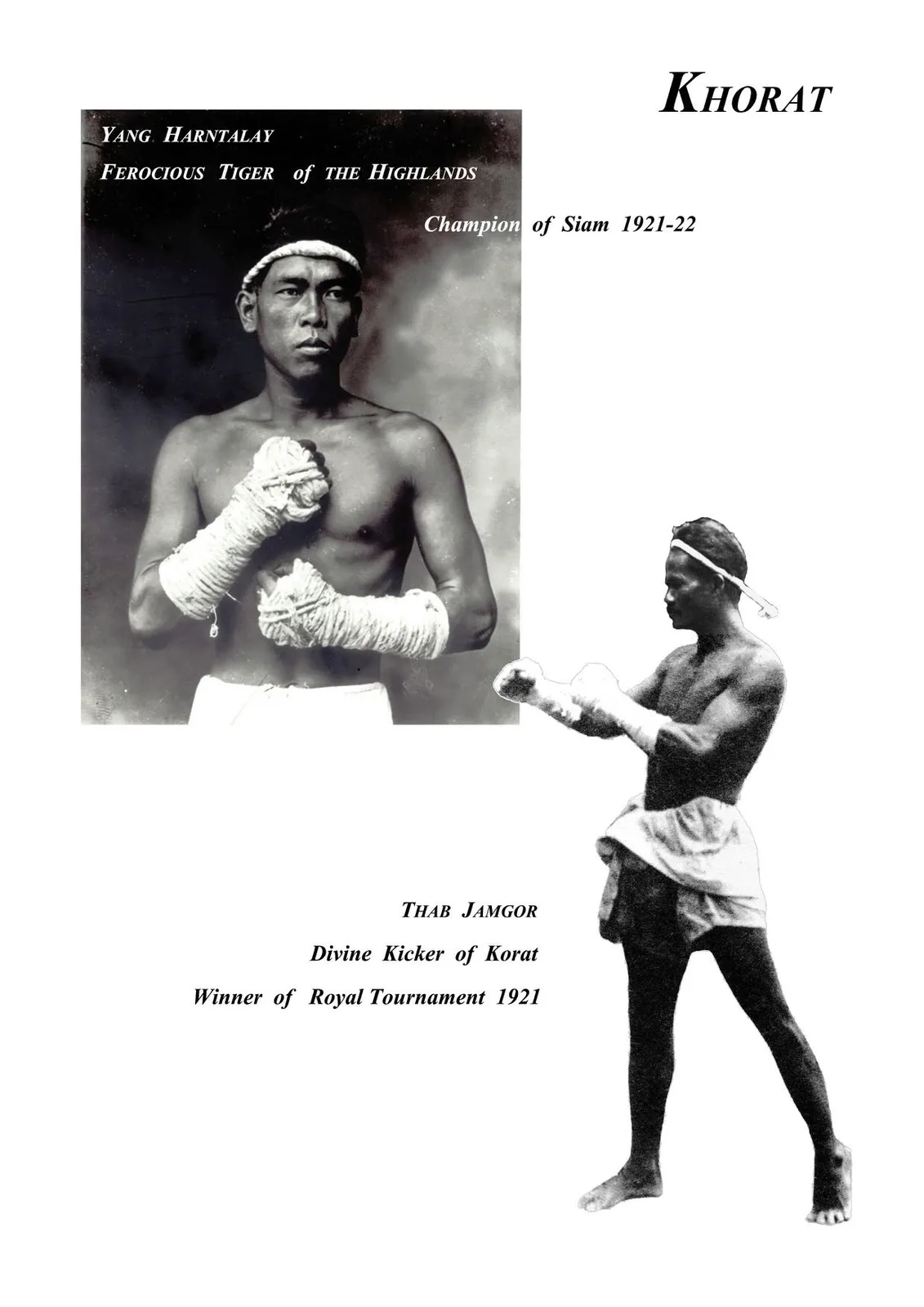
The pride of muay Korat - Nai Yang and Nai Thab, Suan Kularb period.
Nai Yang, the veritable Jack Dempsey of Korat, is known for his high kicking and extraordinary craft in the ring. At 33 years, he has had over 150 fights in all, as well as being the No.1 fighter of Korat, a pedigree that won him the status as one of the top boxers of the time. Lately, he was however humiliated in a one-round defeat in the hands of Bangkok champion Niyom Thongchit, in a special contest marked by colors of political flavor, allowing use of Japanese Jujitsu tactics. His opponent, Chi Chang (子正 ) coming from Northern China via Hong Kong, is a champion and expert in the traditional (Eagle-fist Style) combat art, and also famous for mastery of Qigong. Reputed to have won over 100 fights, the Tiger General of Chinese Guoshu has come to Siam through the strong desires of the local Chinese community, only realized by the positive involvement of the Dr. Sun Yat-Sen Revolution Alliance HQ in Siam. Though more senior in years, he has the advantage in size and experience over his 130-pound Siamese counterpart. It is the showdown, of the native Siamese boxing art, against the widely celebrated, and secretive, Chinese national heritage in fighting. After completing their respective form of ritual, Boxing Commissioner Phya Nontisen Suranapakdi cited the rules governing the eleven-round match. The Thai fighter, hero of Isaan, is attired in customary muaythai fashion, with both fists wrapped in rounds of cord, while the Chinese guru, donning a white vest, claret trunks, shin guards of like colour, is bare-fisted. On the sound of a siren, and drum beats, the fight of the century begins… A few probing moves and turns by each opens the drama. Yang advances to attempt a powerful swing, but twice he tries and misses, as the Chinaman, displaying great command and deftness, handily avoids the assaults. The Thai tries a right kick, which also waves past his man…. The action draws applause from the spectators. Then suddenly, a high left kick of Yang flashes out, lands flush on the chin of the Chinaman, instantly knocking him to the ground. He struggles to rise, yet in no condition to fight any more, he concedes defeat.
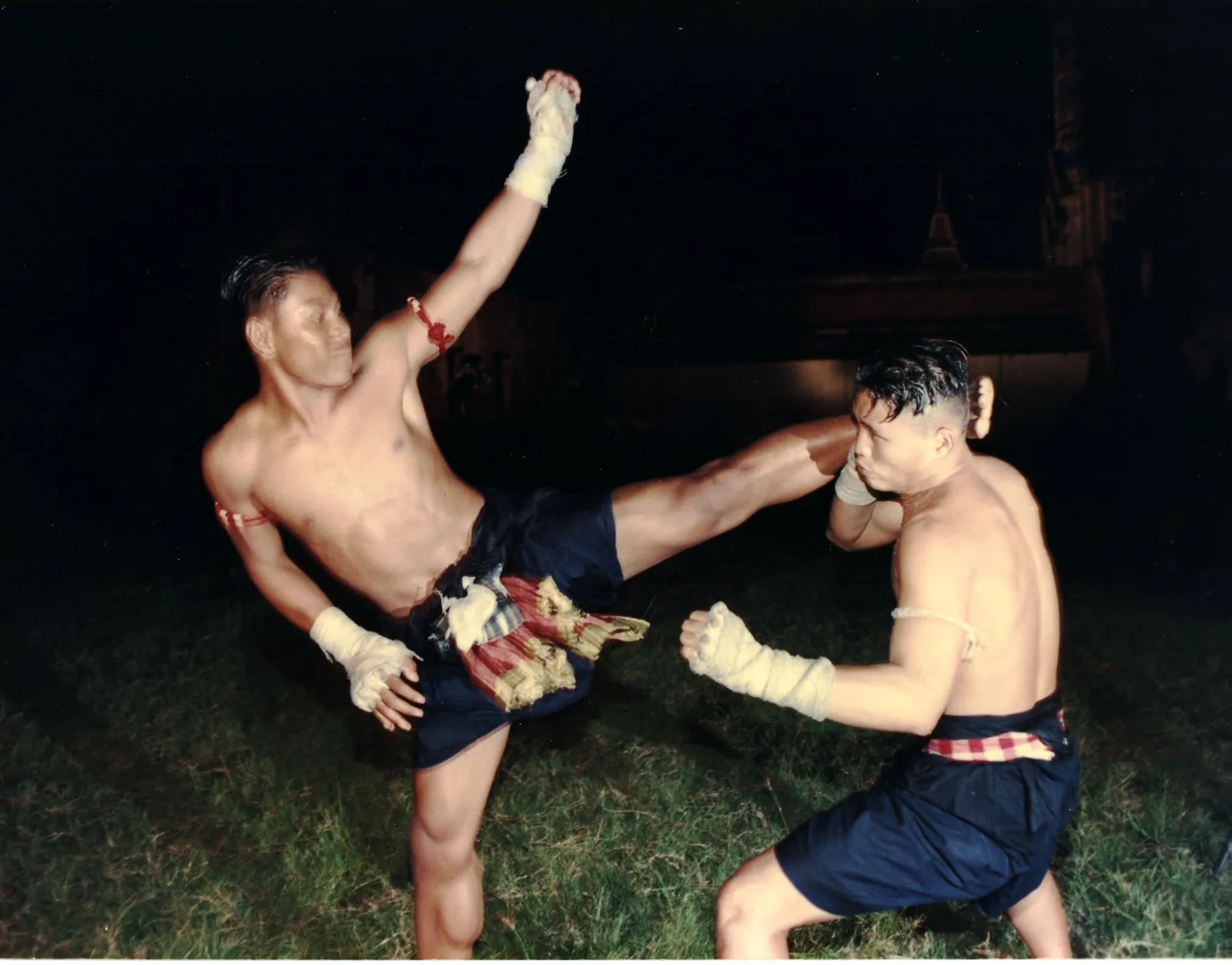
Prototype muaythai high kick to the head - impact on the ear and instep hooking on the back of the neck- double trauma.
The abrupt K.O. has the audience enthralled in momentary silence, before an outbreak of ovation and joy filled the ground. Yang, for his brisk performance, was rewarded with a purse of 100 bahts, a silver necklace, the precious Tiger Medallion, and ceremonial garlands. The two-day programme grossed a remarkable 20,090 bahts in gate revenue and lottery sweeps. The Bangkok Recorder noted : “….although to the profound regret of the partisan Chinese residents, none of their compatriot boxers was able to win, everyone accepted that it was nonetheless a good cause.”
(To be continued)